 Write a comment
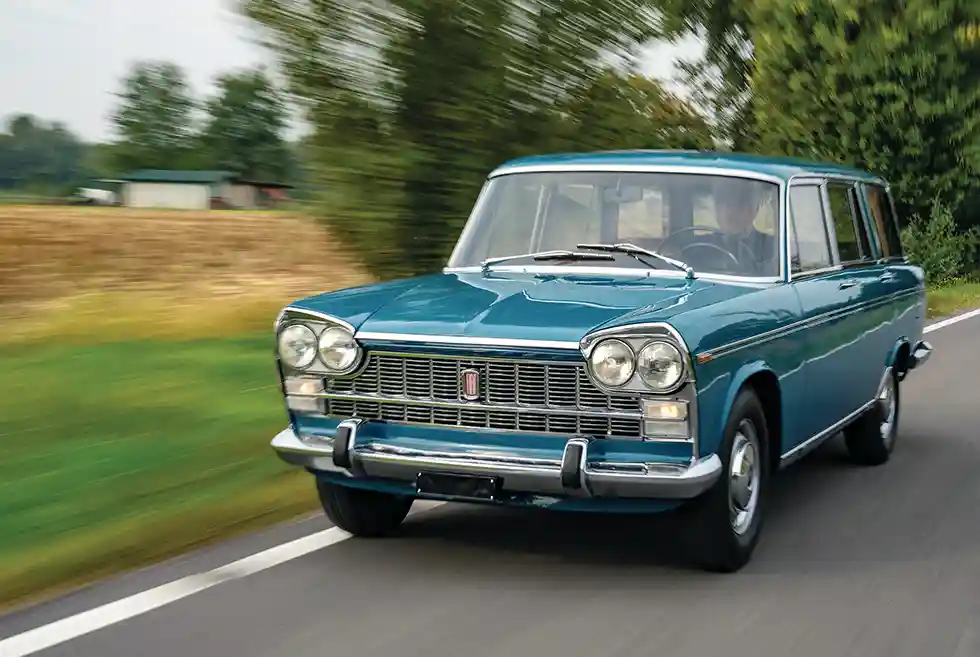
With seating for six, a huge luggage area, exceptional versatility, and a smooth yet capable six-cylinder engine, the Fiat 2300 Lusso Familiare remains one of the most unusual and refined estate cars ever produced by Fiat. It was the only factory-built six-cylinder Fiat wagon, and in its most luxurious form, it offered a rare blend of comfort, practicality, and understated prestige.
Largely overlooked in period by Italian buyers - many of whom still saw estate cars as tools for tradesmen rather than family transport - the Fiat 2300 Lusso Familiare was, in reality, an elegant long-distance cruiser: reassuring, spacious, and genuinely sophisticated. Today, it stands as a highly distinctive and collectible classic, especially in restored condition.
Why the Fiat 2300 Lusso Familiare Was So Unusual
Until well into the 1980s, Italian buyers were generally reluctant to embrace estate cars. Wagons were often viewed as strictly utilitarian vehicles, suitable for artisans, delivery work, or commercial use, but not for private owners seeking style or status. Most families preferred owning a small sedan alongside a separate work vehicle instead of combining both roles in one car.
That attitude is clearly reflected in Fiat’s sales figures during the 1960s. Estate cars accounted for only a modest share of overall production across the brand’s model ranges. Even when wagons sold reasonably well, they were still niche products compared with their sedan equivalents.
Among Fiat’s better-known estates was the 500 Giardiniera, which reached 13.5% of total 500 sales in 1963. The 1100 Estate did better on average, with wagon versions making up around 14.6% of production during the decade. But larger, more prestigious Fiat wagons were far rarer—especially those fitted with six-cylinder engines.
A Rare Luxury Wagon in a Market That Didn’t Want One
The six-cylinder Fiat 1800, 2100, and later 2300 belonged to a more exclusive class. These were large, comfortable touring cars aimed at buyers wanting more refinement and performance. In wagon form, however, they remained highly specialized vehicles.
The Fiat 1800 B Familiare sold in greater numbers than the more expensive 2300 wagon, partly because buyers who wanted a premium sedan typically chose the 2300 saloon instead. The 2300 sedan already offered a huge 450-liter trunk, more than enough for holiday luggage. Buyers tended to choose the estate only if they needed to carry bulky sports equipment or large family loads.
As a result, the Fiat 2300 Familiare represented only a small fraction of total 2300 production, making it one of the rarest variants of the model line.
The First and Only Official Six-Cylinder Fiat Estate
The six-cylinder Fiat 1800 and 2100 were introduced at the 1959 Geneva Motor Show, and their estate versions were significant for two reasons.
First, this was the first and only time Fiat officially offered a six-cylinder car as a station wagon. Second, it was also the first time Fiat launched a model range with an estate version available from the start, rather than adding it later.
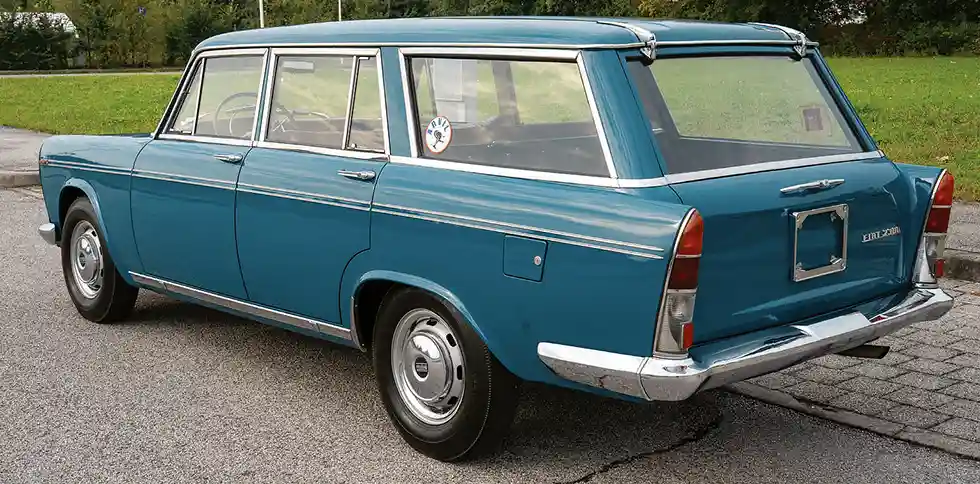
Its American-inspired two-piece tailgate was one of its standout design features. The upper glass section lifted upward, while the lower tailgate folded down. This practical arrangement made loading easier and allowed access even when parked close to a wall.
Because production numbers were relatively low, Fiat outsourced the construction of the estate bodywork to Carrozzeria Savio, a respected Turin coachbuilder known for producing niche vehicles and specialist body conversions.
American Style Meets Italian Engineering
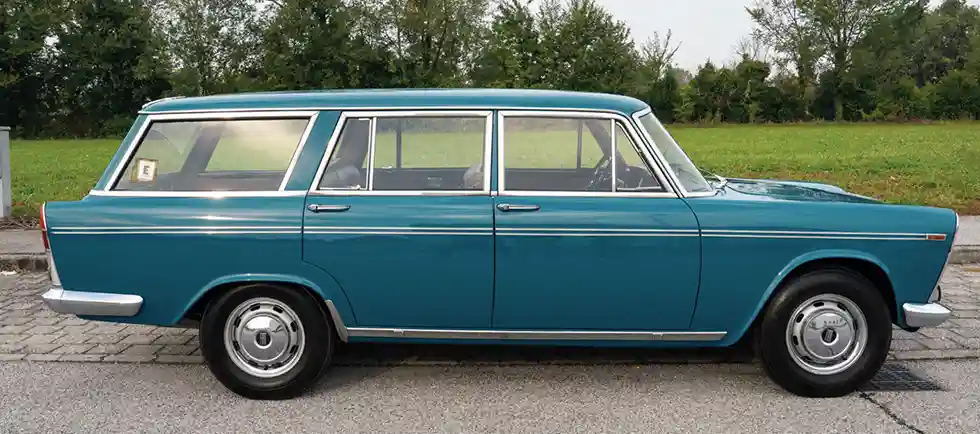
With its long roofline, angular proportions, and distinctly American-inspired styling, the Fiat 2300 Familiare had a visual presence unlike most contemporary Italian cars. It looked substantial, elegant, and practical all at once.
Under the hood was an equally interesting mechanical package. The engine was developed by Aurelio Lampredi, the brilliant engineer who had previously worked at Ferrari and would later create Fiat’s famous twin-cam engine. This inline-six featured an overhead-valve layout with a side-mounted camshaft, pushrods, and rocker arms, but it was far from basic. It used inclined valves and polyspherical combustion chambers, making it advanced for its class.
The original six-cylinder units were tuned more for flexibility and torque than outright performance. They delivered smooth power, making these big Fiat wagons ideal for long-distance touring rather than aggressive driving.
From 2100 to 2300: More Power, Better Dynamics
In May 1961, Fiat updated the six-cylinder range. The 1800 became the 1800 B, while the 2100 was replaced by the 2300. The changes were more than cosmetic.
The rear axle was simplified to improve both handling and load space. The new setup used conventional leaf springs and an anti-roll bar, replacing the more complicated earlier arrangement. This also allowed the spare wheel to be relocated beneath the trunk floor, creating a flatter and more usable cargo area.
Braking also took a major step forward. The previous drum brakes were replaced by disc brakes with servo assistance and a rear pressure limiter, giving the 2300 far more confidence-inspiring stopping power than many cars of its era.
The engine grew from 2,054 cc to 2,279 cc, and power increased from 82 hp to 105 hp. Top speed rose accordingly, with the Fiat 2300 reaching around 155 km/h, while later road impressions suggest real-world performance could approach 160 km/h.
The Arrival of the Fiat 2300 Lusso
In March 1963, Fiat introduced the updated 2300 Lusso. Most of the styling revisions focused on the sedan, which received a redesigned rear end with a higher trunk lid to recover lost luggage capacity. The estate, however, remained visually close to the earlier 2300 Familiare.
The most obvious exterior change on the 2300 Lusso Familiare was the addition of rubber bumper guards on the front overriders. Otherwise, the wagon retained the earlier rear body design.
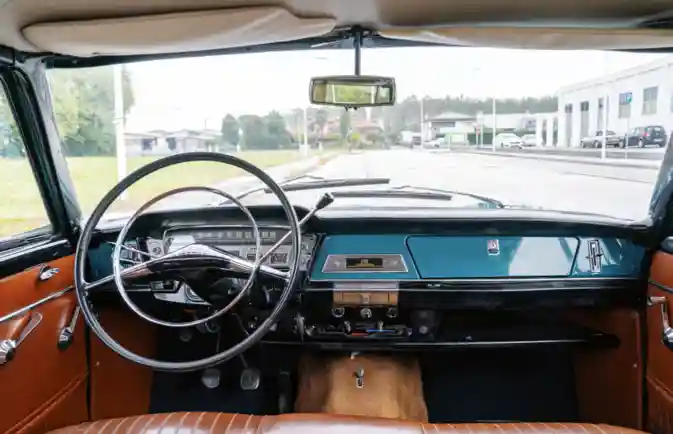
Inside, the differences were more interesting. While the sedan gained separate front seats, the Familiare kept a front bench seat, allowing it to carry six passengers. That made it even more practical for large families, though Fiat never offered rear folding jump seats, so capacity remained limited to six.
Why Sales Stayed So Low
Taxes and insurance costs on six-cylinder cars were very high in Italy at the time, which heavily restricted demand for large-engined Fiats. The wagon versions were even rarer, sold in extremely small numbers.
The Fiat 2300 Familiare Lusso sold in tiny annual volumes:
-
119 units in 1963
-
88 units in 1964
-
142 units in 1965
-
57 units in 1966
-
105 units in 1967
-
47 units in 1968
These low figures meant Fiat had little reason to invest further in the model. Beyond small detail updates—such as wheel color changes in 1964 and optional air conditioning from 1966 onward—the six-cylinder Fiat estates remained largely unchanged until production ended in November 1968.
Driving the Fiat 2300 Lusso Familiare Today
Compared with the sedan, the Fiat 2300 Lusso Familiare feels even more welcoming inside thanks to its wide front bench seat. Visibility is excellent, and the large side windows and rear glass create a bright, airy cabin. Despite its added length, the wagon remains surprisingly manageable because of its squared-off body and easy-to-judge proportions.
At idle, the six-cylinder engine is quiet and smooth. It does, however, require a proper warm-up. When cold, it can feel reluctant and unpleasant, but once fully up to temperature, it becomes wonderfully progressive, refined, and creamy in delivery.
The column-mounted gearshift is impressively ergonomic, with a well-chosen spread of ratios and easy operation. If there is one weakness, it is the lack of a fifth gear. Above 80 km/h, an extra ratio would reduce engine speed and cabin noise—especially in the wagon, where the large interior acts like a resonance chamber.
Steering is very heavy at parking speeds unless the car is fitted with optional power assistance, but once on the move it feels reassuring and communicative. The real surprises are the brakes and ride quality. The four-wheel disc brakes are powerful, progressive, and remarkably resistant to lock-up. For a car of this age, stopping performance is exceptional.
Ride comfort is equally impressive. Despite its relatively simple rear axle, the suspension absorbs road imperfections with real precision. Body roll is noticeable in corners, but it contributes to the relaxed, graceful feel that defines the car. This is not just a practical estate—it is a station wagon with genuine class.
Fiat 2300 Lusso Familiare Technical Specifications
Engine
-
Engine code: Fiat 114B.000
-
Configuration: Inline 6-cylinder, longitudinal front-mounted
-
Block: Cast iron
-
Cylinder head: Light alloy
-
Valvetrain: Overhead valves, side-mounted camshaft, chain-driven, pushrods and rockers
-
Displacement: 2,279 cc
-
Bore x stroke: 78 x 79.5 mm
-
Compression ratio: 8.8:1
-
Power: 105 DIN hp at 5,300 rpm
-
Torque: 17 mkg at 3,000 rpm
-
Carburetor: Solex 28-36 DCD 3 twin-choke
-
Cooling: Liquid-cooled
Transmission
-
Layout: Rear-wheel drive
-
Clutch: Single dry plate, hydraulic operation
-
Gearbox: 4-speed manual + reverse, column shift, fully synchronized
-
Final drive ratio: 4.300
Chassis and Body
-
Body style: 5-door estate with two-piece tailgate
-
Seating: 6 seats
-
Construction: Steel monocoque
-
Front suspension: Independent, double wishbones, longitudinal torsion bars, anti-roll bar
-
Rear suspension: Live axle, longitudinal leaf springs, anti-roll bar
-
Brakes: Girling disc brakes front and rear, dual-circuit hydraulic system
-
Steering: Worm and roller
-
Turning circle: 11.5 m
-
Wheels: 4.5 x 14 steel wheels
-
Tires: 6.40-S14
Dimensions
-
Length: 4.540 m
-
Width: 1.620 m
-
Height: 1.485 m
-
Wheelbase: 2.650 m
-
Front/Rear track: 1.345 m / 1.307 m
-
Fuel tank: 60 liters
-
Kerb weight: 1,285 kg
Performance
-
Top speed: 160 km/h
-
Fuel consumption: 11.9 l/100 km
Production and Rarity
Between June 1961 and November 1968, Fiat produced approximately 97,000 examples of the 1800/2100/2300 range across all body styles. Exact figures for the estate versions alone are not available, but surviving evidence confirms that the 2300 Lusso Familiare is exceptionally rare.
Its scarcity, combined with its unique place in Fiat history, makes it one of the brand’s most intriguing collector cars.
Current Market Value
Today, a well-preserved Fiat 2300 Lusso Familiare is worth at least €18,000, which is:
-
around 50% more than a comparable sedan
-
roughly 40% more than a 1800/2100 estate
That value is more than double what these cars were worth a decade ago. The real challenge is not pricing—it is simply finding one.
A 1965 Survivor Saved From the Scrap Yard
One of the most compelling stories attached to this model is that of Silvano Carraro’s 1965 Fiat 2300 Lusso Familiare, a car he famously rescued from the scrapyard.
Only 558 examples were registered across six model years, making it extremely difficult to find one today. Carraro’s car, finished in Blu Pavone, was first registered on September 21, 1965, in the province of Vicenza. He saved it in 2016 after it had been off the road since 1977.
The car had no documents, and the roof had been damaged while sitting in the yard. Its restoration required:
-
roof repair
-
new chrome trim
-
fresh paint
-
brake system work
-
water pump replacement
-
alternator repairs
-
radiator work
-
removal of an old LPG fuel system
Carraro, an electrician from Casale sul Sile near Treviso, is known for collecting unusual Italian cars with more than five seats. His garage includes rare and distinctive models such as the Lancia Flavia Francis Lombardi, Fiat Multipla 6 posti, Fiat 1400 B Limousine, Fiat 1800 Limousine, and Fiat 2300 Lusso President, along with more conventional classics and coachbuilt specials.
His restored 2300 Lusso Familiare perfectly illustrates why this Fiat deserves greater recognition today: it is rare, elegant, practical, and completely unlike almost anything else in the brand’s history.
Final Thoughts
The Fiat 2300 Lusso Familiare is one of the most overlooked luxury wagons of the 1960s. It combines American-inspired styling, advanced Italian engineering, six-cylinder smoothness, six-seat practicality, and true long-distance comfort in a package that few enthusiasts know well today.
For collectors seeking a rare and distinctive Italian classic, this is far more than an old Fiat wagon. It is a forgotten flagship estate—an automotive curiosity with real charm, real usability, and rising market appeal.