 Write a comment
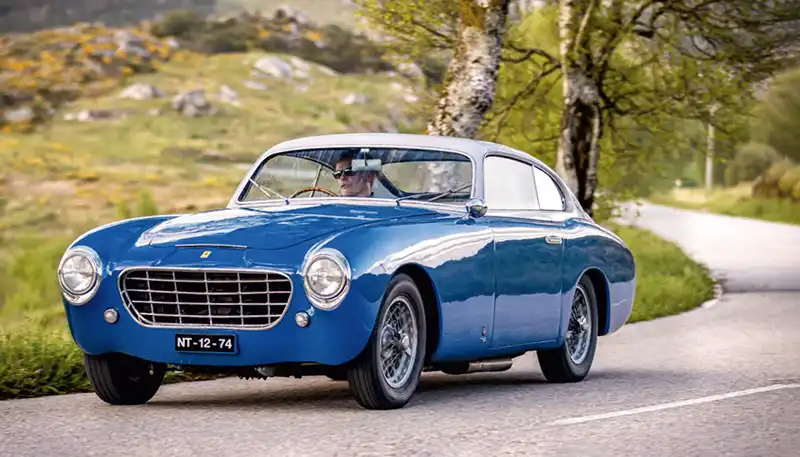
Enzo might have considered road cars a necessary evil to fund racing, but, as Richard Heseltine finds with this 1951 Vignale-bodied 195 Inter, the result was sublime. Photography Luis Duarte.
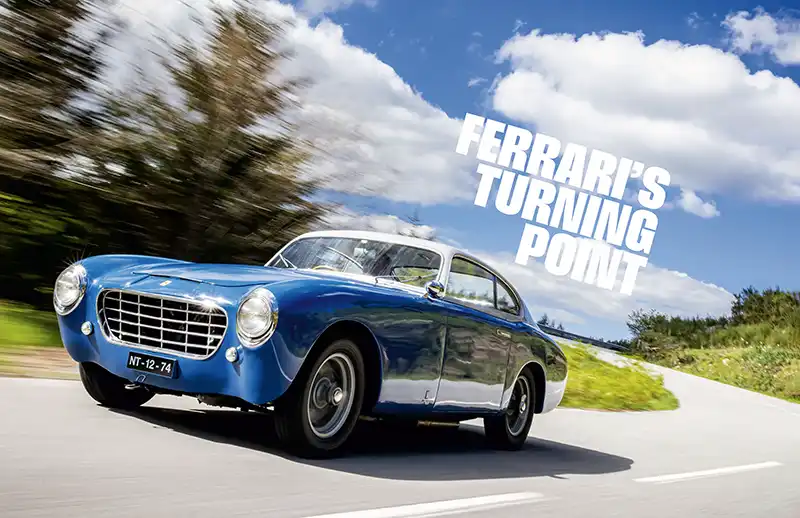
FERRARI 195 INTER
On the road in a rare coachbuilt example of Il Commendatore’s early-1950s change of heart
To the left, there’s a big drop that will surely lead to the big sleep. To the right, there’s a rockface. Directly ahead, and closing, are cows. Lots of cows, none of which seems keen to deviate from their grazing line. We are in an area that is not within walking distance of anywhere, some of the lanes being little more than a series of ruts punctuated by axle-busting potholes. With the benefit of hindsight, inadvertently off-roading in a one-off coachbuilt Ferrari wasn’t a bright idea but, hey, what a backdrop for photography. Its custodian, meanwhile, offers a sanguine look. It’s just another day in these parts, you surmise. Could be worse; it could be raining.
‘IT TAKES PRACTICE TO GET THE MOST OUT OF THE INTER. ULTIMATELY, THOUGH, IT IS REWARDING’
There’s only one thing for it: full-steam reverse. An afternoon in the company of this Vignale-bodied 195 Inter is educational. It is a thing of wonder, but backing out of a narrow pass along an ex-road is hardly its métier. Once onto the smooth stuff, though, it’s much happier, as are we. At the point of its fullest fury, it sounds glorious. It is physical to drive, demands your undivided attention, and a lengthy spell blatting up and down a mountain leaves you feeling dizzy with fatigue and privilege.
As our chaperone is wont to point out, this is the sort of car you drive hard until your speed gets uncomfortable. Then you back out. Not that you could ever accuse it of being anything other than a GT car. That was rather the point. In many ways, this Ferrari (and variations on the theme) marked the jumping-off point for the marque as a purveyor of exotica aimed at The Beautiful People. This is a fast car for something made three-quarters of a century ago, but it doesn’t feel particularly… racy. It wasn’t designed to be guided along on its lockstops.
It is much too dignified for that. It’s worth recalling that industry and infrastructure in Italy had fallen into bleak ruin by the end of World War Two. It was against this backdrop that Enzo Ferrari became a car manufacturer. Scroll back to December 1937 and he had been exiled from Alfa Romeo, the competition department having been created in his image. The terms of his severance meant that he was barred from building a car under his own name. Aside from creating a brace of Auto Avio Tipo 515 sports cars, Il Commendatore would have to wait until the hostilities were over before he could realise his car-building ambitions.
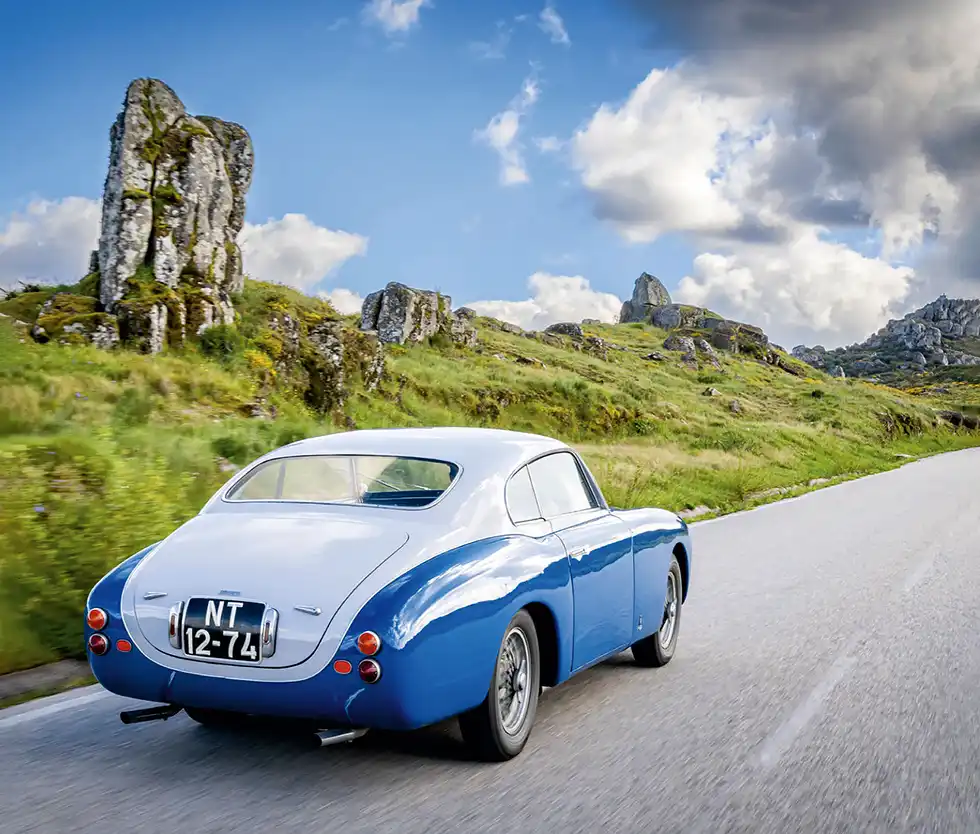
It fell to Gioacchino Colombo to engineer this brave new world, the 125 S being the fruit of their combined efforts. By early 1948, the car’s V12 engine received a capacity hike to 1995cc (from 1496cc), the latest 166 model establishing the marque on the world stage. Ferrari bagged honours on that year’s Targa Florio and Mille Miglia races. The 166 also won the first post-war 24 Hours of Le Mans, held in 1949, with Luigi Chinetti remaining at the helm for all bar a few laps in the car belonging to his codriver, Lord Selsdon. Ferrari – the man and the brand – was in the ascendent. It was at this juncture that thoughts turned to making road cars, by which we mean something usable rather a roadregistered sports-racer with token nods to what might now be referred to as ‘compliance’. Which is not to say that Enzo’s heart was really in it. They were a necessary evil; a way of funding his nascent Scuderia. Even then, road car production for much of the 1950s was patchy, comprising mostly of small-series runs. To begin with, at least, most cars left the factory in rolling chassis form. It was the responsibility of outside coachbuilders to make them whole. The 166 Inter was the first true Ferrari road car. It arrived in 1949 and the largerdisplacement (2341cc) 195 Inter variant was unveiled at the following year’s Paris Salon de l’Automobile. Even then, there were two iterations: the regular Inter boasted a single carburettor, the Sport a triple-Weber arrangement. A mere 27 cars were made before production ended in mid-1951, Alfredo Vignale’s eponymous outfit being the factory’s favoured couturier before the baton passed to Pinin Farina. Vignale had quite the work ethic, that’s for sure, having embarked on his coachbuilding odyssey in 1924 when he was just 11 years old. The son of a car-painter, he was apprenticed at Ferrero & Morandi in Piazza Enrico, Turin. Six years later, he caught the eye of Battista ‘Pinin’ Farina under whom he would complete his training. Aged 24, Vignale was poached by Giovanni Farina – brother of Battista and owner of Stabilimenti Farina – to be his workshop foreman. The dream of becoming his own boss was never far away, though, and in the evenings he toiled away in his basement fashioning kitchen utensils and bicycle parts alongside his brother Guglielmo – anything to raise the necessary funds, only for Europe then to be plunged into conflict. Vignale was one of many metal-wielding artisans looking for work in peacetime, but pickings were slim until Cisitalia founder Piero Dusio became his paymaster. He hired Vignale to turn Giovanni Savonuzzi’s concept for the 202 SMM Aerodinamico Coupé into a full-scale reality. Other coachbuilders had been approached before him, but they had baulked at the challenge. Vignale relished it. He and colleague Gianni Griffa constructed the prototype’s body in the Stabilimenti Farina workshop. The gig paid for a small room in a former sawmill from which he established Alfredo Vignale & C (later Carrozzeria Vignale). It wasn’t all sexy exotica, though. Fashioning refrigerated storage containers kept the wolf from the door early on, and the first car to wear the Vignale crest was based on a secondhand Fiat Topolino. The charming coupé attracted plenty of attention, and a photo even appeared in The Autocar. The late 1940s also witnessed him forge a profitable alliance with fellow former Stabilimenti Farina alumnus Giovanni Michelotti. The two friends became regular collaborators from 1949. Michelotti would rustle-up renderings to ensnare prospective clients, and Vignale would turn them into three-dimensional reality. Then, in late 1950, Milanese car dealer Franco Cornacchia brokered an audience between coachbuilding’s rising star and Enzo Ferrari. The upshot was that a lot of work was soon put Vignale’s way, with as many as 150 Ferraris emerging fully dressed from his burgeoning carrozzeria up to 1954. The relationship between manufacturer and coachbuilder ended abruptly, though, due in part to a disagreement over money. The car pictured here, chassis 0103S, was the sixth 195 Inter built, and one of 12 bodied by Vignale. It was delivered new to Ferrari’s Portuguese concessionaire João Gaspar on 17 April 1951. The car’s first owner, gentleman racer José António Soares Cabral, used it strictly for road use. It was then sold to Hermano Areias, who entered it in the Campeonato de Arranque do Clube 100 á Hora road race in Lisbon on 8 March 1953. He finished fourth. It was the car’s sole motorsport outing. The Inter later passed to playwright Luís de Sttau Monteiro, who sold it to Carlos Faustino, and so on… The Inter spent much of the 1960s in a state of disrepair in the back of a Mercedes- Benz dealership in Lisbon. It was rescued by João de Lacerda in 1968 and the car has been on display in the Museu do Caramulo (which he founded) ever since. The history file that accompanies the car contains receipts from UK marque specialist Graypaul Motors. A letter from company principal David Clark, written in 1981, outlines why it smoked excessively despite having covered all of 6000km from new (worn piston rings). The museum’s current CEO, Salvador Patrício Gouveia, recalls his mother Margarida driving the car back to Portugal (it was snowing when she departed Leicestershire). Jumping forward in the narrative, the car was restored in the museum’s workshops during the mid-1990s. It had been resprayed in red and then grey at various points. Using the colours of the instruments for reference, the correct blue and silver hues were reinstated. Up close, the Inter is smaller than it appears in photographs. The proportions are a little skew-whiff thanks to the high beltline and bulbous rear end, but it is soberly attractive all the same, unlike some that were bodied by Motto and Ghia. There’s little in the way of tinsel here. The same is true inside, though the combination gauges within the body-coloured dashboard are works of art in themselves. Contrary to expectations, it’s almost airy. You feel a mite perched thanks to the flat seats, and there’s a slightly off-kilter driving position, but that rather goes with the territory. The starting procedure is much as you might imagine. With the fuel pump primed, and following a few jabs at the throttle, you turn the ignition key anti-clockwise a touch until it clicks, then turn it the other way to make contact. The lack of surround-sound fanfare comes as a surprise. You expect that of an ancient Ferrari, but here there’s only a muted burble at idle. The car was upgraded to a triple-Weber set-up in 2001 following an engine rebuild by Philippe Rochat, and it becomes increasingly vocal on the move. The smallcapacity V12 sounds busy as small gears, tiny rockers and little chains whirl and mesh to make music. The sound is quite unlike that made by the larger 3.0-litre 250-series. The single-disc clutch is lighter than you might expect, but there’s no room for slippage. It’s either in or out. There’s no synchro on first but the shift action is less ponderous than preconceptions would have some believe. The close ratios ensure you have to work the five-speed ’box to make progress, which is no great hardship (it’s hard to resist blipping it and changing down for kicks) yet there’s little room for fingertip tactility here: not so much a case of banging in the changes, more that it requires short, sharp throws. Timing is everything. The worm-and-sector steering set-up initially seems stodgy, and the Inter needs more guidance than you might expect at low-ish speeds. It feels decidedly vintage in make-up, but there are no dead spots all the same. It metes out reasonable feedback the faster you travel. While out on a former hillclimb course as a test route, the steering feels leaden in the slow stuff but becomes more communicative on gentle curves and wide sweepers to the point that the sense of heft dissipates. On smooth asphalt, the ride is firm and taut, but you feel everything over uneven surfaces. This isn’t a car that you can just hop into and feel instantly at home. It takes practice to get the most out of the Inter. Ultimately, though, it is rewarding. Given that the 195 produced around 168bhp in Sport spec, it isn’t about to reconfigure your jowls due to excessive g-force loads, but it is spirited uphill and rapid on the level. It comes alive at 3500rpm, and pulls cleanly past 5000rpm. According to its makers, it won’t protest should you stray beyond 6000rpm (there’s no redline on the rev-counter), but given its age and rarity we err on the side of cowardice (I mean caution). As for the drum brakes, they are adequate if not overtly confidence-inspiring. It’s fair to say that some early Ferraris aren’t pleasant to drive, not in a boulevardier style, at least. Maybe that’s the secular equivalent of blasphemy, but it’s certainly proof of the compromises inherent in turning race-bred machinery into a plaything for those more concerned with road-going luxury, and the truest evidence of Enzo’s personal disdain for such creations. This 195 Inter is a sweet old thing, though. It serves as a reminder of a period when Ferraris were fashioned by craftsmen armed with hammers, tin-snips and a good eye; of a time when the Vignale badge denoted more than a Ford trim level. It is also a family heirloom and one that has passed through three generations. It isn’t going anywhere anytime soon, either.
THANKS TO Museu do Caramulo, museu-caramulo.net, and Adelino Dinis. Above You might not call it beautiful, but the Inter marked the beginning of Ferrari’s history as a builder of road cars, and is very much one of the archetypical gentlemen’s GTs of its era.
Clockwise, fromright Jewel-like V12, designed by Gioacchino Colombo, features here in 2.3-litre form, and sounds busy yet less boisterous than larger 250 series; broad roads suit its demeanour; gorgeous instruments in painted dash. Above and opposite The Inter was Ferrari’s first true road car, bodied in this case by Vignale in unique style and repainted in original colours – as found on the intruments; interior is simple yet beautiful.