 Write a comment
The Mercedes-Benz W124 has earned a near-mythical reputation for quality, durability, and understated luxury. Designed under Bruno Sacco, the W124 arrived in 1985 and quickly became a benchmark for engineering excellence. For many enthusiasts, it represents the last era when Mercedes-Benz built cars with a true “built for life” philosophy.
From its bank-vault build quality to its famously dependable engines, the Mercedes W124 estate, known internally as the S124, remains one of the most desirable usable classics on the market. Whether you want a practical family wagon, a dependable modern classic, or a long-term investment, the Mercedes-Benz 300TE makes a compelling case.
Why the Mercedes-Benz W124 Still Matters
There is something instantly reassuring about the W124’s clean, dignified styling. The design is elegant without being flashy, and it carries the kind of quiet confidence that never goes out of fashion. More importantly, beneath that restrained exterior lies one of the most thoroughly engineered cars of its era.
When Mercedes launched the W124, the company was still committed to over-engineering every component. Features such as double-skinned bulkheads, fully galvanised body panels, and exceptional fit and finish made the car feel massively robust. This was a model built to withstand decades of use, not simply survive a warranty period.
Available in saloon, estate, coupé, cabriolet, and limousine forms, the W124 range offered something for nearly every buyer. Yet it is the S124 estate that has become especially admired, combining Mercedes-Benz durability with real-world practicality.
Mercedes-Benz S124 Estate: Practicality Meets Prestige
The Mercedes S124 T-Modell is the version that best captures what made the W124 so special. It offered genuine estate-car versatility while maintaining the refinement, solidity, and prestige expected from a Mercedes-Benz executive car.
In period, it was equally suited to family life, long-distance motorway driving, or business use. Today, that same versatility makes it one of the most usable classics you can buy. It has the load space and comfort of a traditional estate, but with the added charm of old-school Mercedes engineering.
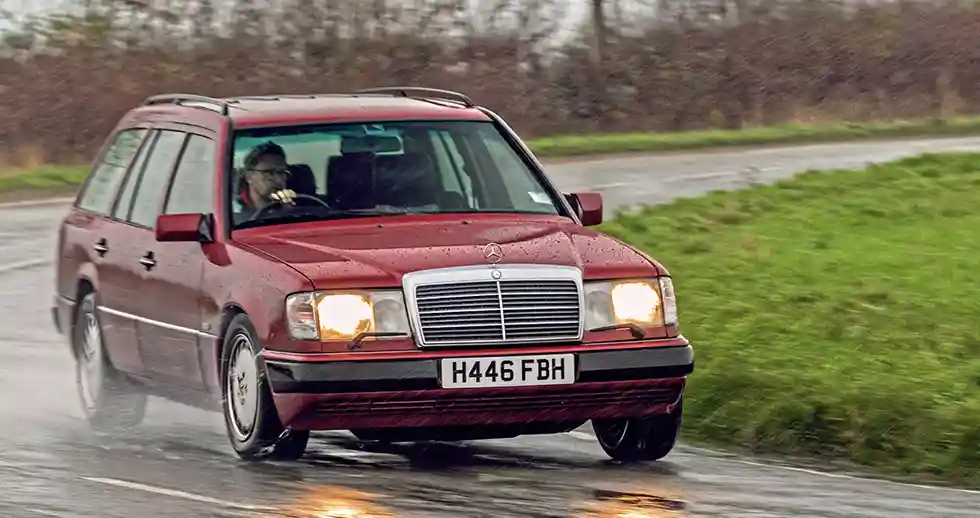
A car like the Almandine Red Mercedes-Benz 300TE perfectly demonstrates the appeal. It doesn’t rely on aggressive styling or attention-grabbing features. Instead, it projects mature, understated quality — the sort of car chosen by people who valued substance over status symbols.
Interior Quality: Classic Mercedes-Benz at Its Best
Step inside a W124 and the cabin immediately explains why these cars have such a loyal following. The seating position is upright and commanding, visibility is excellent, and every major control is placed exactly where it should be.
The dashboard design is simple, clear, and highly functional, with classic white-on-black instruments, logical ergonomics, and tasteful walnut trim. The seats are typically firm, supportive, and hard-wearing, especially in leather-trimmed cars. In the estate, the rear bench folds flat to create a generous cargo area, while some examples also feature the iconic rear-facing jump seats concealed within the boot floor.
It is a cabin designed with longevity in mind, and even today many well-kept W124s still feel impressively solid and free from squeaks or rattles.
Mercedes-Benz 300TE Driving Experience
The Mercedes-Benz 300TE uses the 3.0-litre M103 inline-six, an engine known for its smoothness, refinement, and strong mid-range torque. It may not feel fast by current standards, but it delivers power in a relaxed, effortless way that perfectly suits the W124’s character.
On the road, the 300TE feels composed, stable, and immensely reassuring. The ride quality is supple, absorbing poor road surfaces with ease, while the chassis remains controlled and confidence-inspiring. Steering is light yet accurate, and although there is some body roll, it never feels untidy or insecure.
One of the estate’s most valuable features is its self-levelling rear suspension, which helps the car remain balanced even when carrying heavy loads. At motorway speeds, the W124 truly shines: calm, refined, and unshakably solid.
This is a different kind of luxury car. Rather than trying to impress with gimmicks or drama, the W124 wins you over with depth, integrity, and long-distance comfort.
Mercedes-Benz W124 Reliability and Common Problems
One of the biggest reasons the W124 enjoys such a strong following is its reputation for longevity. Properly maintained examples are capable of enormous mileages, and it is not unusual to see W124 engines cover 300,000 miles or more.
That said, these are now classic cars, so condition matters far more than reputation alone. Most issues are age-related rather than fundamental design flaws.
Common Mercedes W124 Problems
-
Rust is the biggest concern. Check inner wings, behind the headlamps, rear wheelarches, jacking points, and below the rear side windows.
-
Wiring loom degradation can affect post-1992 cars and can be costly if not already addressed.
-
Rear suspension spheres on self-levelling cars eventually wear out, though replacements are readily available.
-
Central locking faults can occur with age.
-
Air conditioning leaks are another known issue on older cars.
The good news is that parts support remains strong. Many components are still available through Mercedes-Benz Classicand the aftermarket, making ownership easier than with many rivals from the same era.
Mercedes-Benz W124 Values and Market Prices
For years, the W124 was overlooked as simply a dependable old Mercedes. That has changed. Clean, well-maintained cars are now increasingly appreciated by collectors and enthusiasts, especially desirable six-cylinder estates.
Typical Mercedes-Benz W124 / S124 Prices
-
Project cars: £2,000–£3,000
-
Usable 300TE with history and 100k+ miles: £5,000–£10,000
-
Excellent low-mileage examples: £20,000+
Diesel models are generally more affordable, but the petrol six-cylinder cars, especially the 300TE, are the most sought after thanks to their refinement and smooth power delivery.
Considering the engineering quality, practicality, and longevity on offer, even strong money for a top W124 can still look like excellent value.
Is the Mercedes-Benz S124 a Good Classic to Buy?
Yes — and arguably one of the smartest classic Mercedes purchases available today.
The Mercedes-Benz S124 estate blends classic styling, everyday usability, robust engineering, and genuine long-term ownership appeal. It is practical enough to use regularly, elegant enough to feel special, and durable enough to justify the investment.
It may not be as exotic as some classic rivals, but that is part of its charm. The W124 doesn’t shout for attention. Instead, it quietly delivers exactly what a great car should: comfort, dependability, and timeless quality.
For buyers who want a classic car they can actually drive and enjoy, the Mercedes-Benz 300TE estate remains one of the best all-rounders on the market.
Owner Experience: Living With a Mercedes-Benz S124
Hak Simsek bought his S124 around ten years ago after searching for an estate that could serve as both a family car and a dependable daily driver.
He paid just £1,700 in 2015, which now seems remarkably cheap for a car of this quality. Since then, ownership has been largely trouble-free. The main repairs have involved rust around the rear quarterlights and front wings, plus routine maintenance items including a water pump and a cold start sensor.
Despite considering newer estate cars, he remains loyal to the S124. His verdict is simple: for the money, few cars offer the same blend of usability, quality, and durability.
1989 Mercedes-Benz 300TE Specifications
Engine: 2962cc inline-six, 12-valve, SOHC, Bosch K-Jetronic fuel injection
Power: 178bhp at 5700rpm
Torque: 188lb ft at 4400rpm
Transmission: Four-speed automatic, rear-wheel drive
Steering: Power-assisted recirculating ball
Front suspension: Independent, lower wishbones, coil springs, telescopic dampers, anti-roll bar
Rear suspension: Independent multi-link, coil springs, gas sphere dampers, suspension struts
Brakes: Front vented discs, rear solid discs, servo-assisted with ABS
Top speed: 136mph
0–60mph: 8.4 seconds
Weight: 1480kg
Fuel economy: 25mpg
Cost new: £17,840
Classic price guide: £1,850–£8,500