- Body: Coupe
- Engine: Flat-6
- Fuel: Petrol
- Drive: RWD
 Write a comment
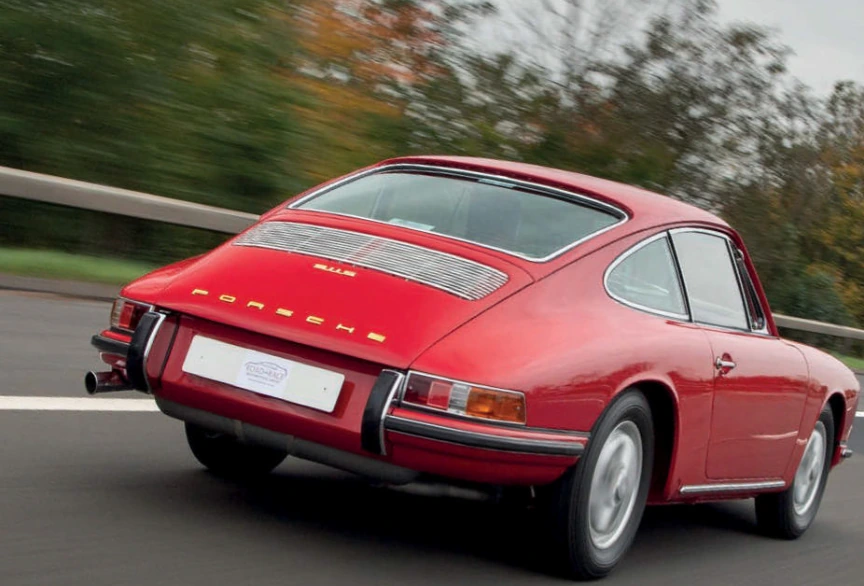
Following a lifetime in the USA, John Bradshaw’s stunning two-litre 911 S has been fully restored by the talented team at Road & Race Restorations, the Porsche-approved repair centre he established back in 1988...
Personal Best
We’re regularly asked about the cars owned and driven by the restorers we feature in our pages. Do these specialists practice what they preach? Truth be told, it’s not unusual for professionals working with a specific make or model to hop into an entirely different vehicle at the end of the working day, claiming the need for a ‘change of scenery’. One could argue this sends out a mixed message to the company’s customer base (rules for thee, but not for me). Even so, we can all agree the desire to break from what could be perceived as tunnel vision is entirely understandable. Thing is, though, none of the Porsche specialists I encounter ever tire of the brand and its products. Even if these individuals have spent all week underneath P-cars, they look forward to hopping into one during evenings and weekends. Just as it is for the many marque enthusiasts reading this magazine, the vast majority of professionals working in the Porsche sphere possess unbridled passion for the manufacturer, its history and its output.
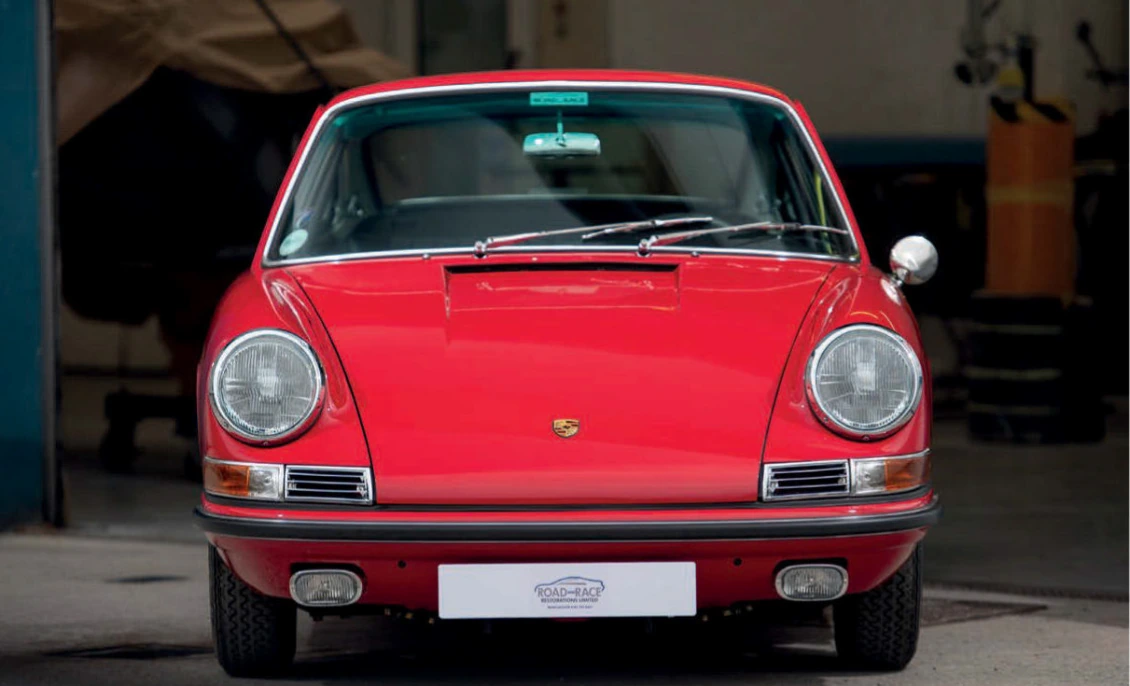
Proving the point is John Bradshaw, founder of celebrated independent restoration and body repair business, Road & Race Restorations (visit road-and-race.com ). Based in Manchester, but now also operating from a recently opened site in Cheshire, the company is one of a handful of body repairers recommended by Porsche. Essentially, this means the firm’s facilities must meet strict operating standards determined by the manufacturer. Criteria is updated as technical developments are introduced to the Porsche product range and are based on “the qualitative processes and workmanship expected by Porsche”. Specifically, this means Road & Race Restorations must consistently maintain its compliance with the required training, tooling and equipment standards, as well as adhering to the repair processes as set out by Porsche for the repair of its products. Needless to say, manufacturer-approved repair facilities, such as this, are continuously monitored and are regularly (independently) audited. Signalling its uncompromising approval for the work John’s team produces, Porsche Cars Great Britain has handed a choice selection of its own projects to Road & Race Restorations, not limited to the resurrection of 924 GTP 002 (a veteran of the 24 Hours of Le Mans) and a two-litre short-wheelbase 911, which was configured for use in the popular Peter Auto 2.0L Cup series. Although it’s true to say the company currently finds itself primarily occupied with the repair of accident damage inflicted on modern Porsches, there’s still room for air-cooled classics, as evidenced by the beautiful early 911 S pictured on these pages. Who cuts a hairdresser’s hair? Who takes the pictures at a wedding photographer’s wedding? What restored Porsche does a restorer of Porsches drive? I’m not sure what the answer is for the first two questions, but the latter mystery is solved by way of eyeballing this 911. Completed in February 1967 and supplied to the US domestic market, the car spent most of its life in Florida, as John explains. “I don’t mind admitting the history file is lacking,” he tells me, “not helped by the fact I acquired the car from the previous owner’s estate following his death.” Knowledge regarding this coupe’s life is frustratingly sparse. “I was in America buying six or seven old Porsches to bring to the UK for restoration. The collection included a notchbacked 356 and a 911 E. A customer had asked me to source an early 911 S for a project, but most of the examples I encountered during my stay in the US were either too expensive or had been messed about with. I was in New Orleans when the call came through. It was the day I was due to fly home. A friend in Texas was reaching out with details of this Polo Red Porsche, which he explained was a non-runner, but very original.” The supplied photographs indicated the presence of all equipment peculiar to the early 911 S. With space on John’s shipment from the US to Britain, the car was soon making its way across the Atlantic ocean.
Lost In Transit. Unfortunately, it didn’t arrive exactly as it left Uncle Sam’s back yard. “There was a wooden steering wheel supplied with the Porsche, but it was stolen somewhere along the way,” John sighs. “The other odd thing about this 911 was the location of its rust. The bodywork had corroded in weird places. In the UK, we fully expect to discover compromised metalwork around the wheel arches, along the sills and so on. Here, however, the roof was rusty, as were the window rebates, rear seat bowls and the area around the torsion bars. Paint on the uppermost surfaces, including the engine lid, was seriously cracked. It occurred to me the car was likely kept outdoors and had suffered prolonged exposure to Florida’s blazing sunshine. Condensation was almost certainly forming on the bodywork at night, then evaporating under intense heat during the day. Years of this cycle repeating is what I think resulted in the car’s unusual cosmetic condition.” Further inspection revealed the need to restore the inner front wings and floor pan alongside installation of a new roof and torsion bar bores. “Quite a big job,” John continues. “There was no accident damage, but the restoration work demanded use of a jig. We thought we might get away with saving the roof, but we found it had rusted through the rear guttering. The car was very straight, but we deemed fresh metal the best course of action.” The doors showed no sign of previous repair, but the outer skins were corroded. The window frames were in good order, as was all brasswork, but the aluminium casings for the quarterlights were broken. “New front panel, quarters, wings, rear panel, roof, seat bases, door skins. The more we delved into this 911, the more material we realised we needed to replace. I reiterate there was no evidence of collision damage, just the effect of exposure to the elements for many years. Oh, and a whack inflicted on the car at the docks during import.” The engine, meanwhile, was seized to the point the pistons needed to be drilled from their liners.
The project commenced in 2012, but three years in, the commissioning customer demanded a halt to proceedings. As is often the case with long-term projects, life has a habit of getting in the way. “After a bit of toing and froing, the then owner told me he wanted to sell the car. Fine, but we had a problem insofar as this was a 911 in a million pieces. Furthermore, Porsche parts prices have increased dramatically in the wake of Dieselgate, making the job less appealing to many enthusiasts than it would have been a few years earlier. With a limited audience, it was difficult to recognise where the car would end up.” Well, kind of. You see, John is a big fan of the early 911 S and, with this example already in the process of being brought back to life in the Road & Race Restorations workshop, he decided to put the car’s owner out of his misery by offering to take ownership of the build as a personal passion project. All well and good, until you realise the curse of the Porsche restorer is the fact specialists rarely have time to dedicate to their own cars on account of all the customer builds demanding attention. Ultimately, as anyone in business will attest, paid work must take priority. “The usual story,” John laughs. “Never getting a chance to fix what needs to be fixed on your own cars.” The company’s day-to-day operations are now managed by his son, Tom, a stalwart of Porsche motorsport and winner of the 2025 Porsche Great Britain Sprint Challenge series, which he contested in a Toro Verde 718 Cayman GT4 RS. Both Bradshaws are dedicated to delivering a first-rate customer experience, meaning taking staff away from client work and shifting their focus to the 911 S was out of the question. “It ended up on the backburner,” John shrugs. Time has a nasty way of passing without being noticed. Fast-forward to 2018. It looked very much like the 911 S might end up being a victim of ‘out of sight, out of mind’, but with the car feeling sorry for itself in a corner of the increasingly busy Road & Race Restorations workshop, one of the firm’s talented technicians took the initiative. “Come on, John. Let’s get it done.” This friendly nudge served as the catalyst for completion of the build. “The car needed to go back on the jig, a development serving to focus the mind, primarily because we have a stream of customer cars in need of the same equipment. It’s not as though this 911 could take up residence very long, equating to necessity for the work to be carried out at good pace without interruption.”
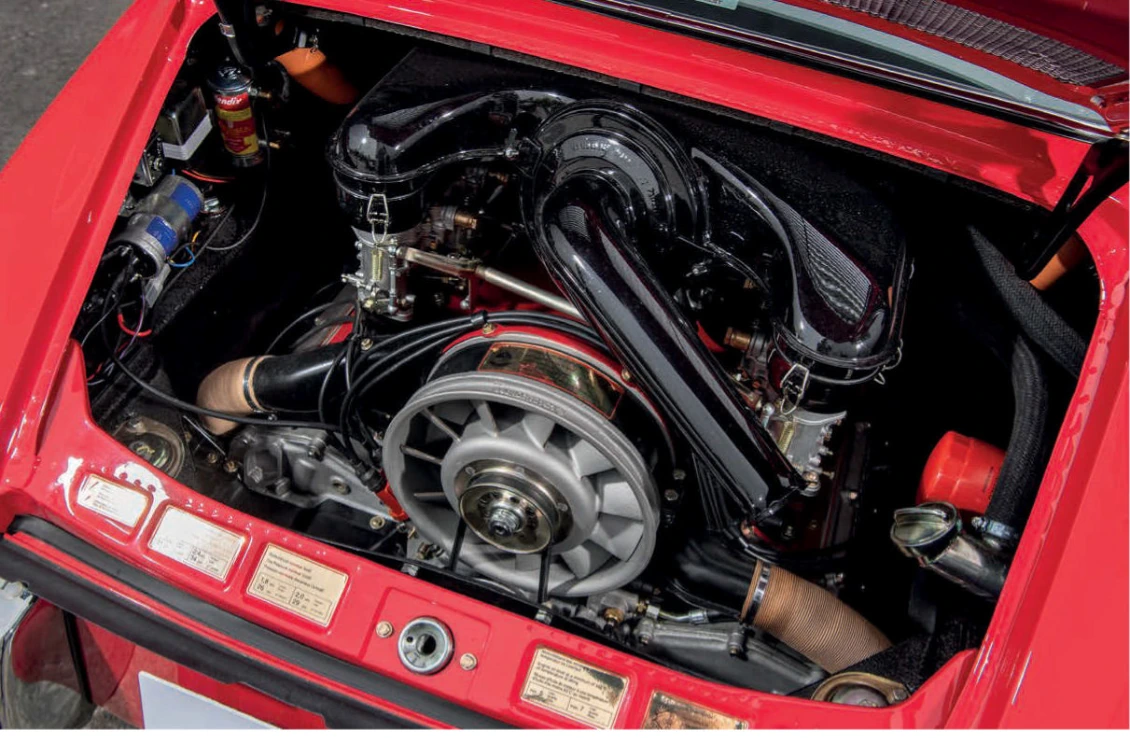
Winning Formula. The engine was handed to Neil Bold, famous for his work on Formula Ford powerplants, and the man who rebuilt the two-litre flat-six powering the aforementioned short-wheelbase 911 owned by Porsche Cars Great Britain. “Other than the pistons being wrecked in the bores, the engine was in excellent overall condition,” John confirms. “None of the lugs on the crankcase were broken and the original carburettors were in fine fettle.” He’s referring to Weber IDS-type carbs, which are configured with a ‘high-speed enrichment’ circuit to prevent engine damage from detonation under load. Incidentally, Weber IDA carburettors, which are a mainstay in the product catalogue of UK-based fuel system specialist, Webcon, are associated with lower-output applications, such as the engine powering the 911 L , though both are centred around a triple-barrel die-cast design. “We think water had worked its way through the carbs, into the inlet and had been allowed to sit atop the pistons. Thankfully, and largely because they’re flat, water didn’t seep into the crankcase.” Minor modification came by way of a 123ignition CDI+ system with Bluetooth control, a Dansk exhaust system and an alteration reducing the amount of oil transferring between cylinder heads and sump, a known problem area for flat-sixes of this nature.
The car’s suspension was complete. Amazingly, even the Koni dampers were original, although have now been stripped, sandblasted, powdercoated and benefit from new inserts. “When we’d finished restoring the body and all of the supporting components, the package was handed to Lee Mayor Restorations, a Preston-based business specialising in sales and assembly of air-cooled Porsches. The relationship we have with Lee is excellent, and his work is first-rate.” Demonstrating how much faith they have in Lee’s skillset, he now takes care of most assembly work for John’s team’s classic Porsche restorations, with the Bradshaw brigade tackling chassis repair, restoration work and paint for Lee’s projects. As a case in point, Road & Race Restorations is currently in the process of finalising paintwork on a Carrera RS 2.7 replica Lee has been working on. Theirs is a fantastic professional relationship serving both parties brilliantly, all to the benefit of each company’s customers, whose wait times are reduced as a result of this fruitful union.
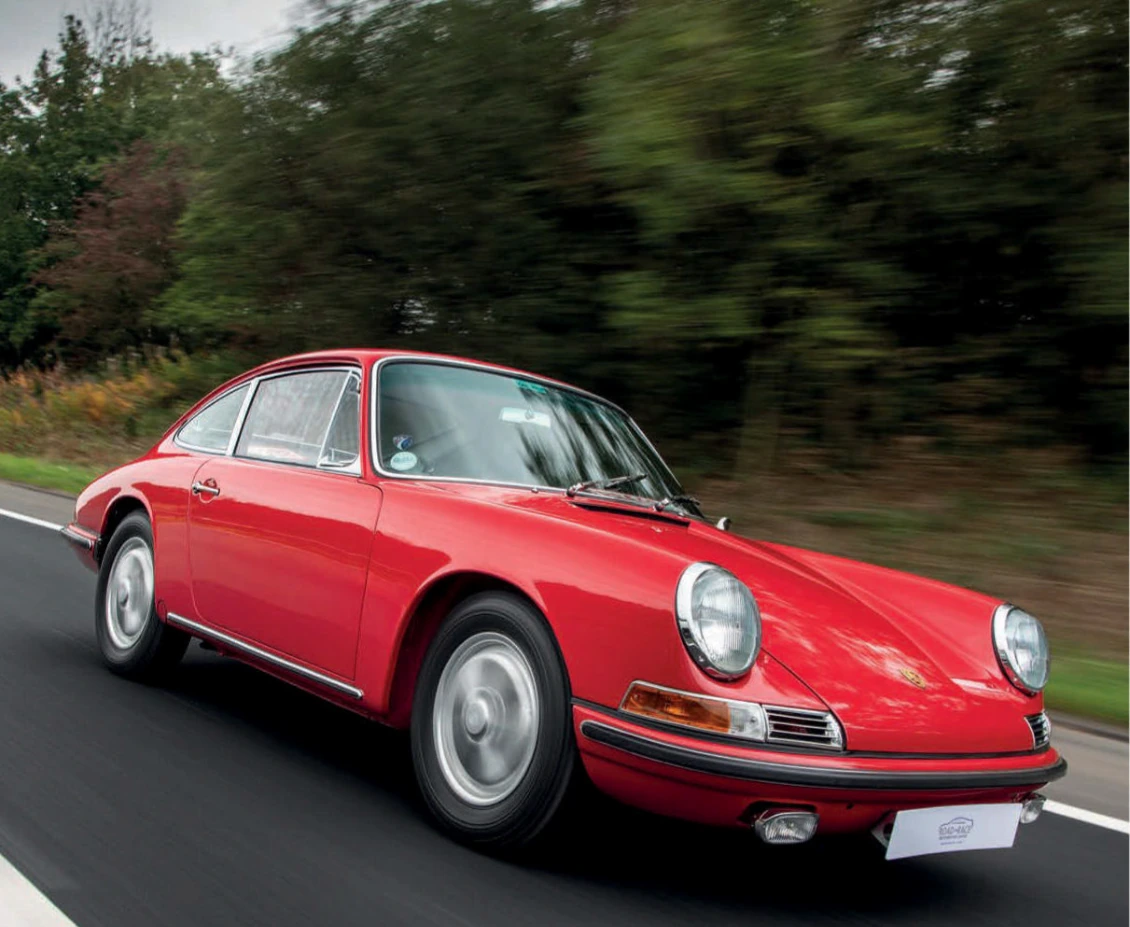
The gearbox was rebuilt by KN Transmissions, Preston’s long-standing supplier of replacement gearbox parts, axle repairs and general transmission diagnostics. Established in 1989, the business is recognised for Haldex unit servicing, clutch work and reconditioning of gearboxes from within an immaculately clean workshop. KN Transmissions also served as the gearbox repairer for the previously mentioned Porsche Cars Great Britain two-litre 911. The interior was trimmed by Michael Greenbank Coachtrimmers, with the dash gauges refurbished by North Hollywood Speedometer, who John rates as the best in the business. “It’s easy to replace old parts with new, but originality is extremely important, which is why we’ve attempted to retain as much factory equipment as possible, only replacing with a new part where it is apparent there is far too much corrosion to deal with. For example, all but one bumper overriders are original to the car, as is the glass, the anti-roll bars and torsion bars.” Remarkably, even the rear brake discs are original. “This was a very rusty car, but it was pretty much all there.” That said, purely on the grounds of safety, a couple of items were given the boot. The original fuel tank is a prime example, as is the car’s Webasto petrol heater, kept to one side, but removed on the grounds of it being a fire hazard.
The dash trim was ditched, too. “It was wood, which might have been a dealer-fit option when the car was new, but not something we’ve seen on a 911 S of this vintage in our workshop. It certainly wasn’t listed as individual equipment on the car’s factory Kardex. We asked Michael Greenbank to retrim the dash inserts in basketweave when he was sorting the seats, which are finished in black leatherette with Pepita houndstooth centres.” All told, the build was completed in October 2025, more than a decade after the car landed on English shores. John freely admits he still needs to finish snagging. “Winter was approaching, which as far as the UK is concerned, equates to less than favourable conditions for hitting the road in an old 911 in an attempt to determine which of its parts are in need of attention.” Will the car be making appearances at the coming summer shows? “This is a great example of the restoration work we produce, which is why it’ll be seen out and about post-snag. I’m keen to showcase the individual talents of the businesses and technicians joining forces to deliver such a brilliant classic 911. Porsche Cars Great Britain has expressed interest in borrowing the car for a range of forthcoming events, too.” Concours competitions? “Not really my thing,” John laughs. “We’re a motorsport family. In racing, results are clear cut. More often than not, whoever crosses the line first is crowned winner. Show and shine? It’s arbitrary, down to the opinion of a judge, which might differ from one to the next. I have no doubt this is a silverware-worthy 911, but concours contests don’t really excite me.” What does excite him is the Porsche brand and its sports cars, especially those of the air-cooled variety. It’s a passion running deep, one recognised by the manufacturer in its decision to appoint Road & Race Restorations as one of only a handful of approved repair centres. And with Tom now at the helm, it’s a passion showing no sign of slowing.