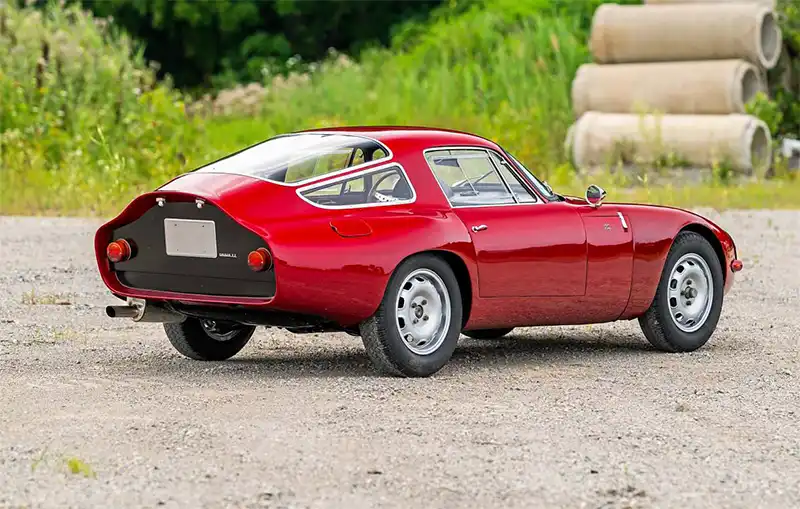
- Year: 1965-1966
- Type: Car
- Body: Coupe
- Power: 112 hp at 6,500 rpm
- Torque: 133 Nm at 4,200 rpm
- Engine: Inline 4 cyl
- Displacement: 1.6-litre
- Fuel: Petrol
- Gearbox: Manual 5-speed
- Curb weight: 640 kg
- Drive: RWD
- 0-62mph: 7.6 seconds
- Top speed: 122mph
 Write a comment
The Alfa Romeo Giulia Tubolare Zagato, built in only 129 examples
Text: Knut Simon
Photos: Darin Schnabel / RM Sotheby’s, Alamy
Famosa Sorellina
“If you want to be valued, make yourself scarce,” as grandmother wisely says. With only 129 examples built, the Alfa Romeo Giulia Tubolare Zagato — the TZ and TZ 2 — followed that advice to perfection.
A famous little sister
Every success has several fathers — and history always has its whims. Together, both led Alfa Romeo to create a car that would be built in just 129 examples. Yes, of course: this is the story of the Alfa Romeo TZ and TZ 2.
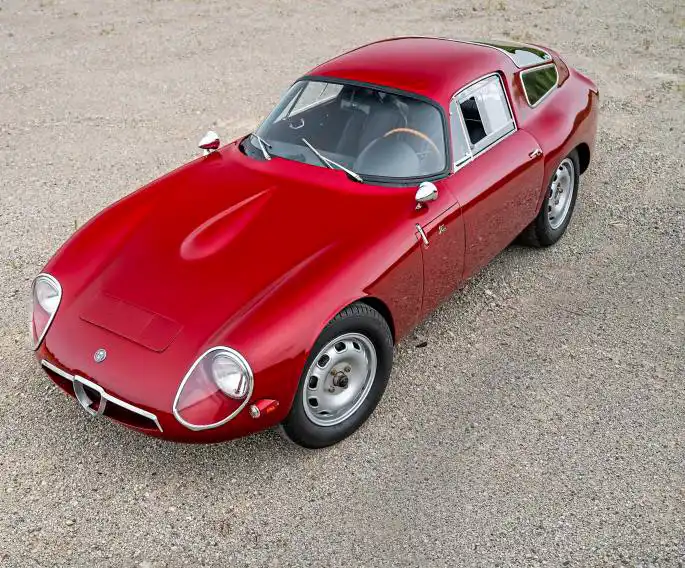
And yes, whims — Italy knows them well. “There is no greater emotion,” as the Italians say. In fact, by 1958 Alfa Romeo was deeply dissatisfied with the fact that its Grand Prix activities had been dormant since 1951. So the company rekindled the old certainty: “Race on Sunday, sell on Monday!” The goal was a new in-house GP racing car.
At Alfa headquarters, someone picked up the phone and called the magician of horsepower: Carlo Abarth. A highly gifted engineer and shrewd businessman, Abarth accepted both the call and the assignment to develop a high-performance Alfa. In principle, that was the initial spark for the Giulia TZ — though not yet its actual birth.
Abarth, the Viennese tuning master, specialized in extracting more power from comparatively small engines. That was exactly why Alfa chose him. From the Giulietta’s 1.3-liter twin-cam engine, he developed a 1,000 cc unit producing 90 hp. Assigned to work alongside him, Alfa Romeo engineer Mario Colucci designed a sensationally light chassis. Built from tubes, the structure proved remarkably torsionally rigid while weighing only 50 kilograms.
Franco Scaglione, then still at Bertone, created the bodywork, and that same year the charming Alfa Romeo Abarth 1000 appeared at the Turin Motor Show.
It went straight onto a siding. Fiat, Abarth’s main client, exerted uncomfortable pressure, while Alfa Romeo’s mercurial management suddenly judged the Grand Prix project too expensive — and perhaps also a little too small.
Was the Alfa Romeo Giulia TZ a child of Enzo’s temper?
But then came a triumphant encore: in 1963, Alfa Romeo’s super sports car finally arrived.
Officially it was called the Giulia Tubolare Zagato Coupé GTZ, with 1,570 cc displacement and 112 hp at 6,500 rpm in homologation road-going form. That was enough for a top speed of 205 km/h.
At 28,950 Deutsche Marks, it cost half as much as a Mercedes 600, exactly as much as a BMW 3200 CS Bertone, and twice as much as a Porsche 356.
And who do we have to thank for that? Once again, a whim — this time the notoriously bad temper of Enzo Ferrari.
In the autumn of 1961, Ferrari had a legendary falling-out with his sales manager and fired him on the spot. The dispute triggered an exodus of several key Ferrari figures, among them development chief Carlo Chiti.
Alfa boss Giuseppe Luraghi seized the opportunity. At that time, under the name Autodelta, he was building up Alfa Romeo’s future racing department. Chiti became its leader, and its initial project was the TZ.
No less a figure than Giuseppe Busso further refined Colucci’s steel spaceframe, making it even stiffer while increasing the weight only slightly, to 62 kilograms.
Depending on the version — road or competition — the Giulia could be ordered with either a 1.3-liter or 1.6-liter engine. In both cases, the engines were tilted by 20 degrees under the sharply descending hood. The classic double overhead camshafts, paired with twin 45 mm Weber dual carburetors, delivered not only goosebump-inducing sound but also sustained high revs.
In racing trim, with 155 hp, the lightweight 640-kilogram car could reach 240 km/h.
Designed by Spada, inspired by Kamm
For the body, Zagato assigned designer Ercole Spada, who had only recently created the Alfa Romeo SZ.
At first, as its creators had intended, Spada clothed the Giulia TZ as an open two-seat barchetta. It looked beautiful, but its driving performance was less than satisfactory. That changed radically when Spada made an equally radical cut.
A longtime admirer of German aerodynamic pioneer Wunibald Kamm, Spada — as he had done with the Giulietta Sprint Zagato — chopped the TZ’s thin aluminum body almost vertically at the rear. He also optimized the front.
In principle, the TZ became the big sister of its stillborn predecessor, the Alfa Romeo Abarth 1000, though it is more often described as the little sister of the Ferrari 250 GTO.
In an Alfa Romeo, even Al Pease didn’t look quite so bad
From the 1964 season onward, class victories began to fall one after another like dominoes.
After further modifications, the car achieved a specific output of over 100 hp per liter. Admittedly, in the class up to 1,600 cc, the Alfa lacked serious rivals — apart from the Lotus Elite. But that did nothing to diminish its popularity.
Even Canadian Motor Industries (CMI) imported a TZ in May 1965 — the very example shown on these pages. CMI entered it in no fewer than eight races that season, once with legend Al Pease at the wheel.
Loaned to Canada Track and Traffic, the magazine’s test editor was impressed by the Alfa’s handling and agility, combined with its absolute controllability.
In 1969, a Canadian couple bought the TZ and kept it for an astonishing 58 years. The emphasis, however, is on ownership, because the car was hardly driven from then on. Beginning in 1989, it entered a slow restoration phase from which it only emerged in 2024.
The TZ 2: flatter, lighter, rarer
By the time that Alfa sports coupé was purchased in 1969, the TZ had already been history for three years.
Under pressure from the arrival of the Porsche 904 Carrera GTS, Alfa launched the TZ 2 in 1966, with 170 hp at 7,000 rpm. It was offered only in racing form, with a fiberglass body. Compared with its predecessor, it was even flatter and lighter.
Officially, including the prototype, only twelve examples were built.
That same year, the FIA raised the homologation requirement for GT cars from 100 to 500 road-going cars sold. At the same time, Autodelta was already working on a hotter version of the Giulia Sprint GT, the GTA, for touring car racing.
The TZ’s sprinting days were numbered.
A million-euro race car that mostly gets pushed
Today, TZs no longer circulate on race tracks, but mainly around collector values and speculation prices of roughly one million euros each. As a result, they are hardly driven at all — except perhaps into enclosed transport trailers.
Often, they are merely pushed.
What an absurd, if not uncommon, ending for a racing car. Yet in its own way, that too is a form of making itself scarce.
Questa è la vita!
Technical Data
- Engine: Inline 4-cylinder, 2 valves per cylinder
- Displacement: 1,570 cc
- Power: 83 kW / 112 hp at 6,500 rpm
- Torque: 133 Nm at 4,200 rpm
- Transmission: 5-speed manual
- Drive: Rear-wheel drive
- Dimensions (L/W/H): 3,950 / 1,510 / 1,200 mm
- Wheelbase: 2,200 mm
- Curb weight: 640 kg
- 0–100 km/h: 7.6 seconds
- Top speed: 205 km/h
- Production period: 1963 to 1967
- Number built: 121
- Price (1964): 28,950 Deutsche Marks
Source: factory figures