 Write a comment
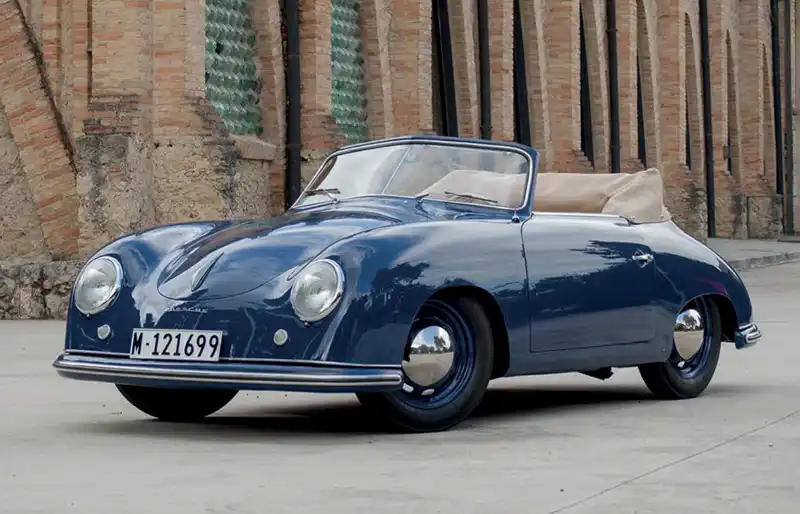
This recently restored 1952 Azure Blue 356 Pre-A Cabriolet is thought to be the first Porsche to land in Spain…
Catalonian Classic
Want to know what an early Porsche looked like when it left the production line? Drink in the delicious details of Rubén Bastida’s 1952 356 Pre-A Cabriolet. Don’t overlook the fact Porsche was barely four years old when this beautiful blue drop-top was built.
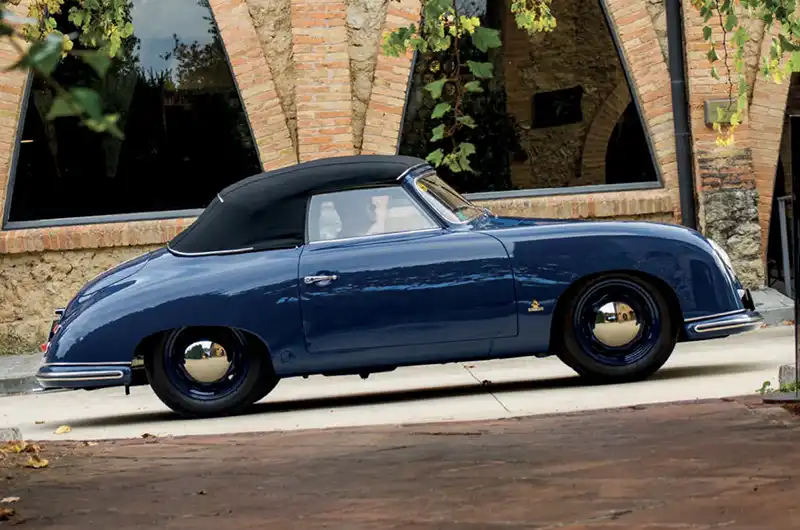
To set the Pre-A in historical context, as well as its specification in 356 chronology, a brief history lesson is in order. The Pre-A name refers to cars built between the 356’s inception in 1949 up to 1956, when the centre- bend windscreen was superseded by what was, by then, considered normal: curved panoramic glass. It’s easy enough to recognise an original Pre-A by its two-piece windscreen, divided by a central bar, a system replaced by single-piece centre- bend glass for the 1952 model year. For clarification, check the photographs on these pages and notice the slight angle located top-centre of our feature car’s front screen — this is one of the very first 356s to receive ‘bent’ glass. Early 356 bodyshells were crafted in steel (as opposed to aluminium, used for the earliest examples) by Reutter Karosserie. Until Porsche’s Zuffenhausen factory premises was handed back by the occupying US military in 1955, post- Gmünd 356s were assembled in workshops leased from the coachbuilder. Stylistic as well as practical evolutions saw the bumpers, previously flush with the body, become detached and sporting overriders in 1953. Rectangular rear lights changed to round ones, along with indicators front and back. A year later, the front indicators were integrated in the horn grilles, brake lights were integrated in the rear lights, while the chrome number plate light module was mounted above the plate itself. Across five years, 356 Pre-A production totalled 9,146 units. The 356 A arrived in 1955. This significant evolution of the original Porsche sports car concept is easily defined by its more panoramic, curved windscreen and the absence of quarter lights in the doors. The sill panels were flat, with a ‘deco trim’ rubbing strip. The rear lights took on what’s known as the ‘beehive’ look. The 356 A Type 2 was introduced in 1957 and displays further detail changes, including relocated bumpers and fifteen-inch wheels with flatter hub caps and Porsche- crested centre caps. Late 356 A Type 2 models feature exhaust tailpipes exiting rather stylishly through the rear bumper overriders, a feature many ‘reimagined’ classic 911s have sought to copy. In terms of shared heritage of engine and transmission, it’s often seen as fair game to point the Volkswagen finger at Pre-A 356s, but this absolutely isn’t the case with the 356 A. Sure, they make use of air-cooled engines with horizontally opposed cylinders, but they share no major components and, it has to be said, very few minor parts. The 356 A models were available with five different engine options, ranging from the basic 44bhp 1.3-litre flat-four to the exotic quad-cam Carrera engine, first seen in the legendary 550 Spyder, complete with bevel-drive overhead cams, twin- plug ignition and 110bhp on tap. Definitely no Beetle bits in that, thank you very much. Bang in the middle (and by far the most popular) of the range were the two 1.6-litre engines: the 60bhp ‘Normal’ and the 75bhp ‘Super’. Sticking with the Volkswagen connection for a moment, it’s a similar story for the chassis. The front suspension and steering system are close to that of the Beetle, with transverse, multi-leaf torsion bars and a pair of trailing arms on each side. Steering is via a steering box, while the rear suspension comprises swing axles with torsion bars and hydraulic dampers. Conceptually, this setup might have Beetle connotations, but there is no parts compatibility worth speaking of. Following the 356 A came the 356 B in 1961 and the 356 C in 1963. Both later models featured ‘upright’ headlights, plus a larger rear window and twin cooling intake grilles. The 1.6-litre flattie was developed to 90bhp, while the final GS-labelled four-cam was stretched to two litres of displacement and offered 130bhp. This engine continued production well into 1964, alongside the then new 911.
Crossing Over. As mentioned at the top of this article, Rubén’s delightful drop-top was manufactured in 1952. This was a ‘transitional’ year for 356 production — somewhat confusingly, from April through September that year, the ‘bent’ windscreen was accompanied by the sleek bumpers, turn signals and rear lights from the earlier split-window model. Additionally, 230mm brakes (essentially, modified Beetle anchors) were a carryover from the earlier 356, with aluminium fins on the exterior of the drums to aid with cooling. At the end of this crossover period of production (September 1952), however, 280mm aluminium drums were standard equipment. 356s built during this busy six months at Porsche in 1952 continued use of a non-synchro transmission. Adding more potential for head-scratching, so-called ‘boomerang’ seats (referred to as such because of the detail on their sides) were installed in 356 cockpits in 1952 and 1953. One major attribute of Rubén’s Pre-A, though, is clear as day — his cool Cabriolet is thought to be the very first Porsche to take up residence in Spain. Manufactured in June 1952, the car continues to be powered by its original powerplant. Carrying factory type number 527, this particular flavour of flat-four is recognised for being the first 1.5-litre Porsche engine, produced between October 1951 through September 1952. Yes, there’s that significant switchover month again. Approximately 750 Type 527s were manufactured, before being superseded by two further developments: the near 55bhp Type 546 and the more powerful Type 528, the latter accompanied by an ‘S’ badge and galloping with the spirit of a whopping seventy horses. The Type 527’s output sits somewhere in between these two engines, nudging sixty ponies and making use of a Hirth roller-bearing crankcase. It’s not unusual for this part to be dismissed in favour of standard equipment in the interests of reliability. Indeed, Rubén confirms his car features this popular update. He also tells us his al fresco 356 was delivered new by Paris-based Porsche concessionaire, Sonauto. This company’s first dealership was located on at 83 Rue la Boétie in the French capital, moving to 22 Rue Paul Valéry in 1953. Where today’s sales cars often carry their issuing dealer’s name and corporate branding on license plates and rear window stickers, Sonauto cars were regularly decorated with elegant exterior badging depicting the company’s logo. In truth, certainly as far as Porsche history is concerned, Sonauto was much more than a car dealer — aided by star driver, Edmond Mouche, company founder, Auguste Veuillet, was in command of the 356 SL Coupe romping to Porsche’s first class victory at the 24 Hours of Le Mans, an accomplishment achieved at the 1951 outing of the daylong enduro. This was, incidentally, Porsche’s first entry at the event. Rubén’s 356 retains both its Sonauto badges. One is positioned on the lower edge of the engine lid, while the second is on the flat- four’s fan shroud, neighbouring the labels suggesting which oil should be used in the flat-four. These badges display Sonauto’s original address, making them super-rare, which is to say almost impossible to find today, as opposed to those showing the Rue Paul Valéry identifier, which are relatively easy to come by. Being a French-delivered Porsche, the car was originally equipped with Marchal headlights. Here’s a fun fact for you to consider. Marchal lamps of this era were Bosch parts modified in France to comply with le nation’s road highway laws, which differed from those in Germany. All Volkswagens and Porsches from the early 1950s were fitted with these Marchal-modified lights, which can be identified by a glass lens with an etched lower third, a design feature introduced to avoid dazzling oncoming traffic at night. Beauty is in the eye of the beholder — many 356 owners (Rubén included) consider the Marchal lamps ugly. Additionally, they’re rarely seen on the used parts market, making them hugely valuable to collectors. You’ll note our star car makes use of boggo Bosch exterior illumination, although it should be noted, even these comparatively-easy-to-find lamps command a pretty penny. Oh, and in case you’re wondering, the Marchal parts have been squirrelled away for safe keeping.
Rubén confirms this gorgeous 356 was purchased new from Sonauto by Spanish gentleman driver, Jose Maria de Caralt, formally known as Count Caralt. A famous racer, he owned several Porsches, Alfa Romeos and Pegasos. He lived fifty kilometres north of Barcelona, in the beautiful coastal village of Sant Andreu de Llavaneras. At the time, the Franco regime’s post-war dictatorship made it almost impossible to register an imported car in Spain, which is why Caralt drove the car with the French tourist plate, 498TT2Y (Paris Transit Temporaire) from 1952 until 1954. To be able to register the car in Spain thereafter, Caralt included the Porsche in a batch of vehicles he designated for motorsport use with Real Automóvil Club de España (RACE). This was one of few ways to get a car manufactured outside Spain into the country, and a milestone Caralt achieved in early 1955, when the 356 was awarded license plate M-121.699.
Private Investigator. In total, the car has had ten owners and, as is the case with many 356s, has led a tough life, as was demonstrated through the myriad scars uncovered on the bodywork during restoration. We’ll come to this work momentarily. Being the super-sleuth he is, Rubén reveals he has the personal details of each of the Porsche’s previous custodians, and has spoken to all surviving owners, as well as descendants of the deceased. Among the ten is Julio Reh, a man famous for racing Pegasos in the 1950s. He owned the Porsche for three years in the mid-1960s. It was rescued in 1972 by a Dutch Porschephile. He’d settled in Malaga after marrying a local woman. Today, he runs a surf shop in the coastal village of La Herradura. Rubén was told the 356 was in poor condition and was being readied for the benefit of a nearby scrapyard at the time of intervention. The price? Seven thousand pesetas, or to use modern parlance, around forty euros. I’ll put my reputation on the line by suggesting the car is probably worth a little more today. In 1977, ownership passed to a Belgian Porsche enthusiast working alongside our man from the Netherlands at a local real estate agency. By now, the car had doubled in value, which is to say it changed hands for the equivalent of eighty euros. Yes, I am laughing as these words fall out of my laptop. Then again, nobody will argue a hundred percent profit is a bad return on investment. Thirteen years later, ownership switched to Jaime Boira, a Spanish collector of air-cooled Porsches. He paid the rather more princely sum of nine hundred thousand pesetas (close to €5,400). He fully intended to restore the car, but during the twenty-four years his name was on its logbook, failed to find the time or resources to realise his dream. To make matters worse, many modern or ill-fitting aftermarket parts had made their way onto the car, including incorrect-for-era front and rear bumpers, seats taken from a 356 A, dash gauges and fifteen-inch wheels from a 356 B, the larger brakes mentioned earlier, as well as a synchronised Type 519 gearbox. Those are the key ownership stories. Rubén took charge in 2014, with a promise made to bring the car back to its best. Clearly, he’s a man of his word. And it gives me huge satisfaction to confirm Jaime, now in his seventies, has been able to see the car given a new lease of life. The work took place across a decade, with parts sourced from all over the world. With an eye on originality, many date-appropriate Pre-A components were provided by the 356 enthusiast community, not least date-stamped parts to replace those lovingly borrowed from later models. Pleasingly, Pre-A owners stepped up and altruistically parted with stockpiles of spares in order to help resurrect Rubén’s Cabriolet, which by the time of work kicking off, was in a sorry state. That said, many new parts were used during the restoration, most through necessity — rubber is a largely organic compound and doesn’t last forever, hence the use of new window weatherstrips, provided (along with other key items) by Tyll Häfner at Classic Parts in Saarbrücken, Germany, who served as one of the consultants on the project, guiding Rubén in tandem with James Davies, a US-based 356 aficionado helping source many parts from the Pre-A owners community and serving alongside Tyll in confirming which model- and year-specific parts should be used during this historically significant Porsche’s reassembly. James’ extensive private collection of photographs documenting details particular to every variation of 356 made the job far easier than it otherwise would have been. The majority of the restoration work was carried out by Retrocar, an automotive bodywork specialist located in Asturias, northern Spain. Rubén confirms more than 1,500 manhours went into the metalwork alone. The engine, meanwhile, was completely rebuilt by Auto Renart in Girona, a flat-four specialist recognised for its work on Beetle boxers. On this note, Rubén is something of a devotee to early Volkswagens, counting no fewer than nine Beetles among his collection of classics. The remaining mechanical parts were refreshed or restored by Retrocar. The interior was retrimmed by Albert Hilario, who Rubén claims to be the best automotive upholsterer in Barcelona. The high volume of Porsches rolling in and out of the Hilario workshop would suggest many local enthusiasts share the same opinion. In case you were wondering, Caralt didn’t register the car for motorsport use only as a means of achieving legitimacy on Spanish roads. He regularly campaigned the Porsche, entering it into the 1952 Rally des Alpes (car number 114, with Prince Paul Alfons von Metternich-Winneburg as co-driver), the 1952 Liege-Rome-Liege (car number 123, with Caralt’s chauffeur, Luis Blesa, second-in-command), the 1953 Firestone Bilbao Rally (car number seventeen, again with Blesa), a return to the Rallye de Alpes that year, followed by outings at the 1954 Subida a Villvidrera (number seventy-eight) and the same season’s Copa Montjuich Sport. Finished in Azure Blue (Glasurit colour code 5408) with dash and door tops in contrasting Maroon (503), this eye- popping Porsche makes use of seats and door panels in beige leather, matching carpets and tonneau cover, with a black fabric roof. Factory options include a Telefunken ID-52 radio and an accompanying Hirschmann aerial. Our photographs were taken at Codorniu, one of the oldest family wineries in Spain, located in Sant Sadurni d’Anola in the Penedès region, dating back to the sixteenth century and famous for introducing Cava to the country in 1872. The winery’s cellars are a significant example of Catalan modernism, built between 1895 and 1915 by famous architect, Josep Puig i Cadafalch, and often referred to as the Cathedral of Cava. This seems entirely appropriate, considering those of us in the Classic Porsche editorial office are about to raise a glass to Rubén for having the determination, patience and wherewithal to take on such a challenging restoration project and see it through to completion. We salute you, Mr Bastida. Congratulations on breathing new life into an air-cooled classic.