 Write a comment
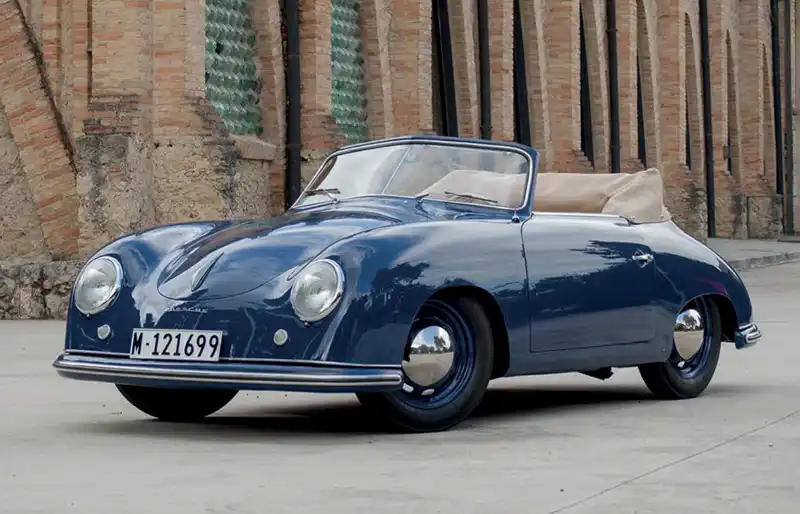
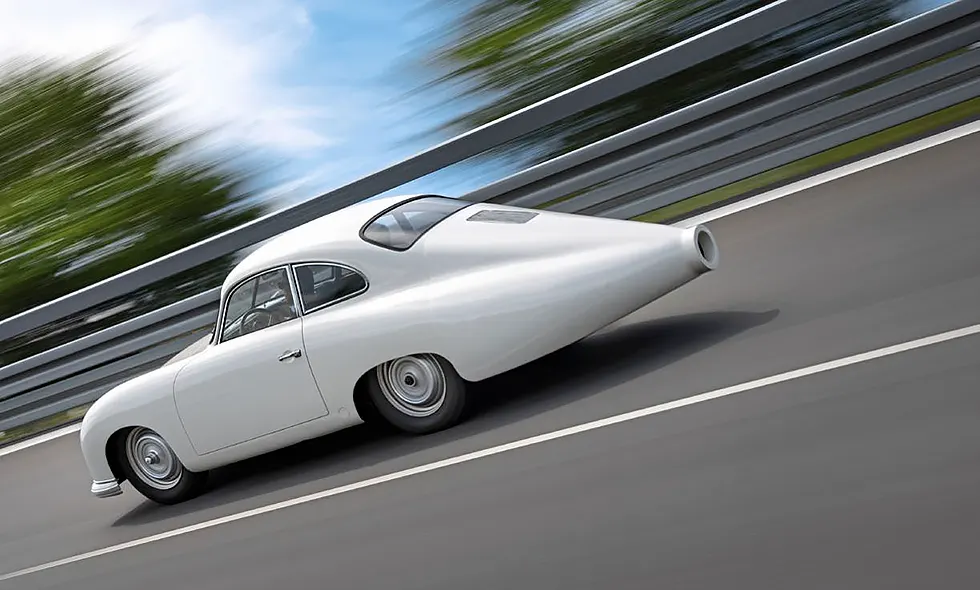
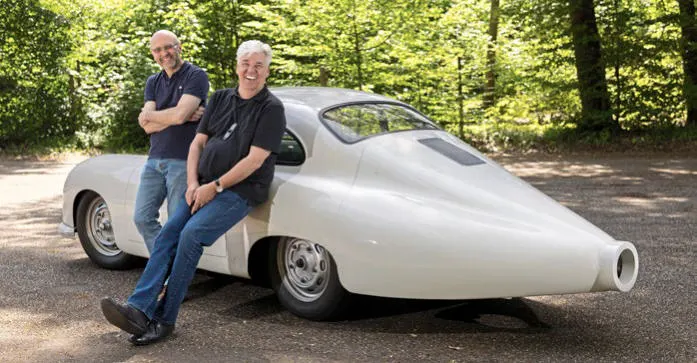
He has done it again. After Dr. Maybach and Brutus, Hermann Layher has brought another historically inspired classic to life: a Porsche 356 with a dramatic streamlined tail. The one-of-a-kind car will make a live appearance at the Grand Meeting.
Gyro Gearloose’s Dream: A Porsche 356 With a Streamlined Tail
Montlhéry, Daytona, the Mercedes test track - I have experienced some of the world’s most important circuits with steeply banked turns. One glaring omission from my résumé, however, was the Bosch test oval at Boxberg in Germany’s Main-Tauber district.
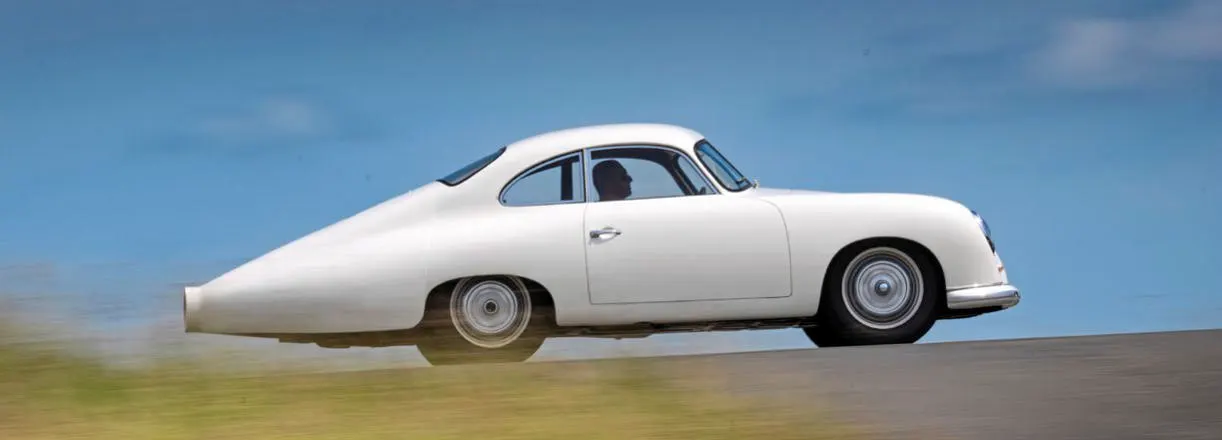
Fortunately, more than two years ago, Hermann Layher, head of the Technik Museum Sinsheim, told me that he was restoring a 1951 Porsche 356 Split-Window. His plan was to equip it with an aerodynamic long-tail body inspired by a historic version from the same year.
Two weeks ago, Hermann called with the news: the car was finished, and we could have an hour on the high-speed track the following Monday. Boxberg’s two great banked turns rise at angles of 65 and 56 degrees.
“The engine isn’t fully broken in yet,” he added. “And by the way, it’s the four-cam engine.”
Oh.
The Early History of the Porsche 356
Before driving the car, it is worth taking a closer look at its history. In 1951, Porsche had been building automobiles for only three years; June 8, 1948, is regarded as the company’s official founding date.
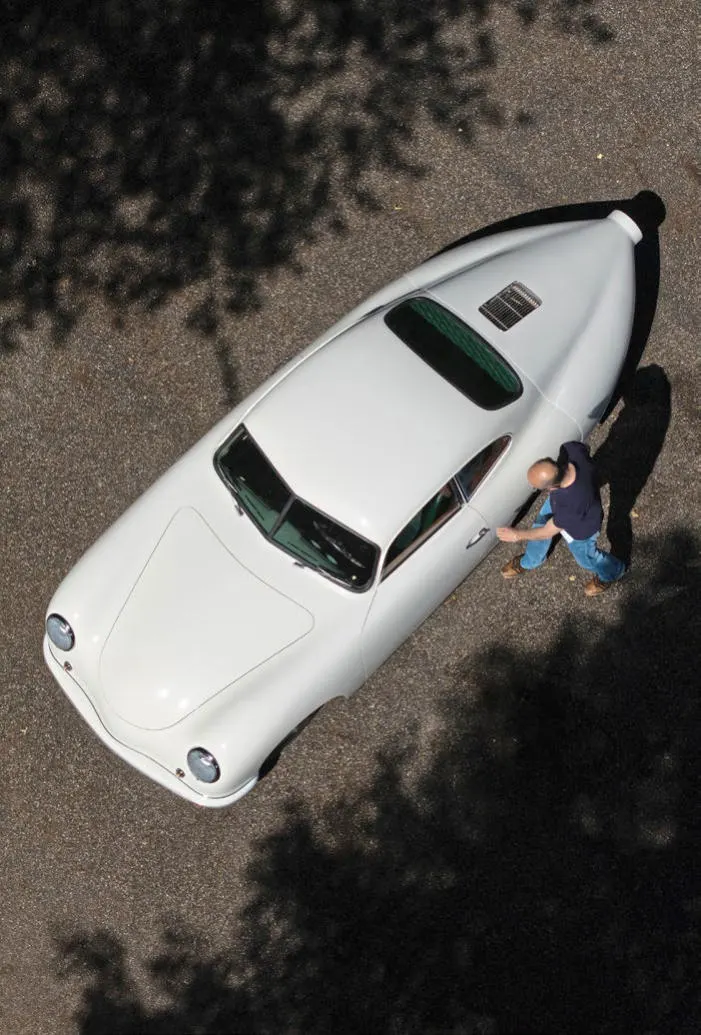
Its sole production model was the 356. After Porsche moved from Gmünd to Stuttgart, the car was built there using engineering that was partly derived from the Volkswagen Beetle. Until 1953, early examples featured a two-piece windshield, earning them the name “Split-Window.” Today, these cars are highly prized by collectors.
The air-cooled flat-four produced about 39 hp from 1.1 liters (67 cubic inches) and 43 hp from 1.3 liters (79 cubic inches), compared with roughly 24 hp in the Beetle. With a curb weight of just 1,720 pounds, the Porsche was capable of around 87 mph.
Buyers also appreciated the fact that the car came from Ferdinand Porsche, the same engineer responsible for Auto Union’s legendary Silver Arrows of the 1930s. As *auto motor und sport* wrote in 1950, the 356 incorporated the same basic design principles used in the advanced chassis systems of Auto Union, Alfa Romeo, and other racing cars.
It is easy to forget just how small Porsche was in those days. Every car was built by hand, and the engineering and racing teams often worked well into the night. The company did not celebrate production of its 25,000th car until 1960.
Even so, Porsche entered a 356 at Le Mans as early as 1951 and returned to Stuttgart-Zuffenhausen with a class victory. That success helps explain why the company can celebrate 75 years of motorsport with such justified pride. Privateers had raced Porsches even earlier, with the marque’s first victory dating back to 1948.
From the beginning, however, it was clear that the pushrod-operated engine imposed strict limits on displacement, engine speed, and ultimately power.
Ernst Fuhrmann and Porsche’s Legendary Four-Cam Engine
Enter Dr. Ernst Fuhrmann. Born in Vienna and later appointed head of Porsche, Fuhrmann began developing a remarkable new engine in the summer of 1952. The first prototype ran on the test bench on April 2, 1953.
The engine that would later bear his name featured four overhead camshafts driven by four vertical shafts. It was extraordinarily complex, but also extremely powerful and remarkably compact.
“I kept the engine as small and compact as possible so that one day I could enjoy this racing engine in my company car,” Fuhrmann later recalled with a grin.
A Forgotten Porsche 356 Split-Window
So how did Hermann Layher find his Split-Window?
“The car was sitting alone in the farthest corner of a workshop,” Hermann explains. “Someone had brought it over from America and practically forgotten about it. Porsche isn’t really my specialty - apart from the Schwimmwagen - so the 356 was a perfect opportunity. And the earlier the car, the better.”
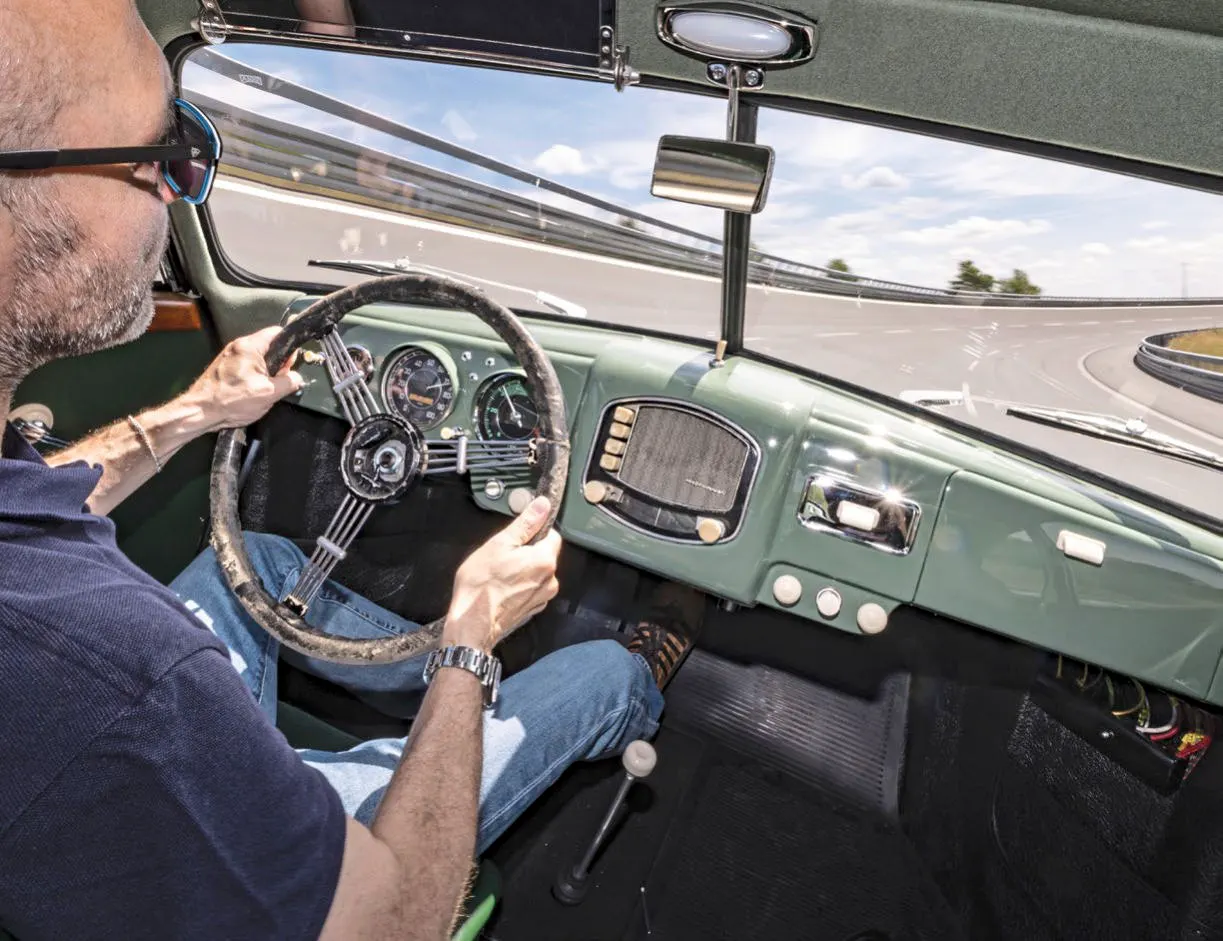
Hermann decided to restore the Porsche in its original white, paired with a green interior. Its most charming detail is the original steering wheel, which visibly—and tangibly - carries the marks of its 75-year history. Patina enthusiasts would give almost anything for it.
But Hermann would not be Hermann without adding a personal twist. His philosophy is simple: engineering should be experienced, and historic cars should be seen in motion.
The most spectacular expression of that philosophy is Brutus, a wild machine powered by a 47-liter (2,868-cubic-inch) aircraft engine, mounted in a chassis with no front brakes.
Inspired by a 1951 Porsche Record Car
During the 356’s restoration, photographs from a private estate came to light. They appeared to document a 1951 record attempt on a section of Germany’s A1 autobahn that had survived World War II. In the images, the Porsche 356 wore a streamlined rear fairing.
Hermann promptly decided to give his own Split-Window a similar long tail. Naturally, the entire assembly can be removed at any time.
The result looks a little like a balloon-powered toy car, inflated through an opening at the rear. But this extraordinary tail is more than a visual statement: it was designed to let aerodynamics play a meaningful role.
To give the bodywork the performance it deserves, Hermann installed one of Fuhrmann’s compact powerhouses behind the rear axle. Engines of this type won countless honors in the Porsche 550 Spyder and its derivatives before becoming available in the 356 in 1955. It is therefore entirely plausible that Porsche may also have tested a Carrera engine in an earlier chassis.
Built by renowned four-cam specialist Karl Hloch, this engine is said to produce around 138 hp. It has been tuned for torque rather than maximum output; today, the aim is drivability, not record-breaking speed.
## Testing the Streamlined Porsche 356 at Boxberg
Enough history. The 1.9-mile track is waiting.
One press of the starter button brings the twin-ignition engine to life with its unmistakably crisp, dry exhaust note. A few blips of the throttle followed by several gentle laps quickly bring its 8.5 quarts of oil up to operating temperature. It is a hot day.
Now it is time to discover how this recreation of a 1951 record car behaves high on Boxberg’s two steeply banked turns.
As always, the four-cam engine is a pure delight. This particular example pulls with unusual strength from low revs. Because it is still being broken in, I do not want to rev it too hard or subject it to sustained high engine speeds. On the straights, I repeatedly let the revs fall before accelerating again.
We stop at 4,500 rpm, which works out to roughly 93 mph. Once fully broken in and able to spin freely to 7,000 rpm, this little white record car should comfortably exceed 124 mph.
Above 87 mph, the 356’s narrow track and skinny tires make the rear end feel distinctly lively in the banked turns. Its very light but imprecise steering demands a delicate touch.
“Even some modern cars have trouble turning into the banking,” one of Bosch’s helpful employees reassures me.
Wider wheels and more modern steering could solve the problem, but Hermann wants none of it.
“In that case, I might as well drive something newer,” he says. “After 620 miles, I’m sure I’ll be used to the steering.”
## Drum Brakes? Absolutely Brilliant
The GT braking system is another dynamic highlight—and a sensible upgrade given the engine’s performance. Its front drum brakes use 2.4-inch-wide shoes and outperform plenty of disc-brake setups.
The finished Porsche is a small Gesamtkunstwerk: a complete work of art with a spectacular presence and one of the most beautiful steering wheels I have ever held.
Hermann now has until the Grand Meeting in early August to finish carefully breaking in the four-cam engine on country roads. I envy him enormously.
Verdict: Should a Rare Porsche 356 Be Modified Like This?
Is it acceptable to transform a coveted Split-Window Porsche 356 worth several hundred thousand euros—even among friends—in such a dramatic way?
Absolutely.
For one thing, every modification is reversible. More importantly, the Fuhrmann four-cam engine delivers performance better suited to modern driving while remaining historically authentic—unlike some newly built flat-four engines.
The extra power means this Porsche 356 is more likely to be driven regularly. And whenever it appears at an event, its streamlined tail is guaranteed to draw a crowd.
## See the Streamlined Porsche 356 at the Grand Meeting
Anyone who wants to see the streamlined Porsche 356 in action—and in its striking white finish—should visit the Grand Meeting at Rittergut Birkhof in Germany’s Rhineland region from July 31 to August 2.
Do not be misled by the new name: this is still the much-loved Classic Days event. Originally held at Schloss Dyck, it later moved to Düsseldorf for a brief interlude. Last year, it found a new home at Rittergut Birkhof, only a stone’s throw from its original location.
The same organization remains behind the event, supported by the same dedicated and highly knowledgeable track marshals.