 Write a comment
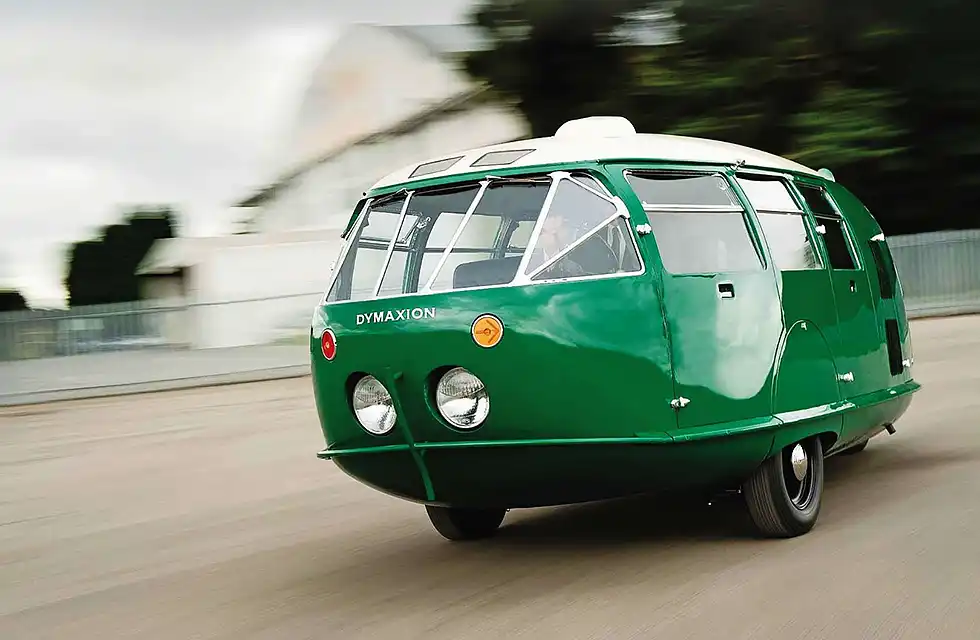
World-renowned architect Norman Foster commissioned a perfect replica of the revolutionary Dymaxion car, one of the most radical automotive concepts ever created. And when the finished vehicle finally rolled out, Octane was invited to witness its first drive.
Words: Tony Dran
Photography: Paul Harmer
Into Another Dimension
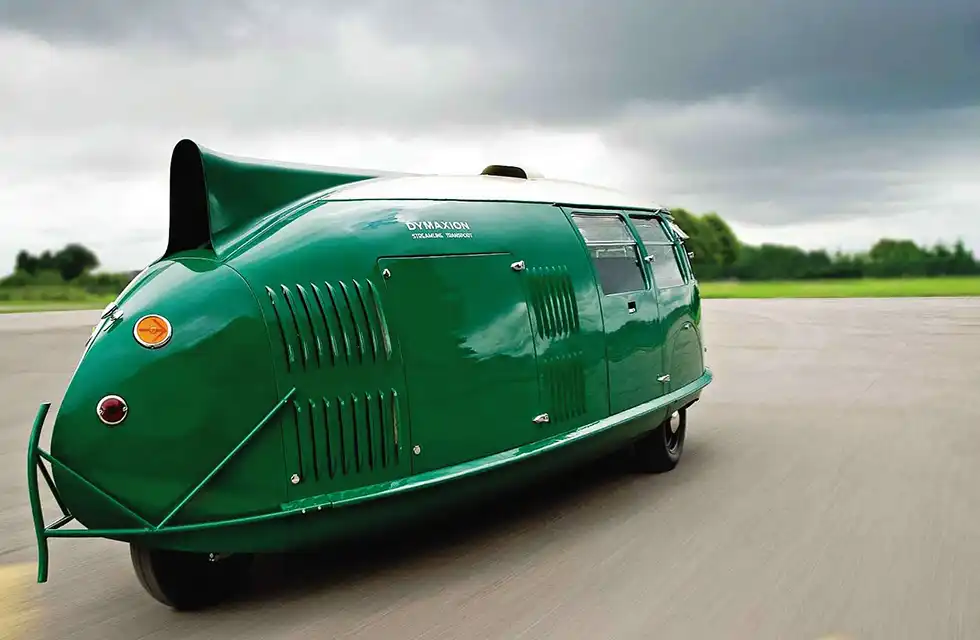
This is the Dymaxion car.
It looks strange, doesn’t it? But driving it is even more extraordinary.
You can smile at its unusual shape if you like, yet the Dymaxion is no joke. Far from it. This futuristic experimental vehicle from 1934 represented one visionary’s ambitious dream for a sustainable future on what he famously called “Spaceship Earth.”
The man behind the Dymaxion was a genius far ahead of his time — a cultured polymath whose revolutionary ideas touched housing, transport, engineering, and nearly every aspect of human activity.
Now his astonishing vehicle has been recreated in meticulous detail. Commissioned by Lord Norman Foster and built by engineering specialists Crosthwaite & Gardiner, the replica captures every feature of the original design. Even today, more than 86 years later, the Dymaxion still provokes questions about the future of mobility.
Of course, skeptics might say this is simply what happens when an eccentric architect designs a car. But that “eccentric architect” was none other than Richard Buckminster Fuller — philosopher, inventor, cartographer, mathematician, futurist and architect.
Fuller’s Dymaxion never progressed beyond the prototype stage, yet it remains one of the most daring design statements in automotive history.
The Radical Engineering Behind the Dymaxion Car
Technically, the Dymaxion is as unconventional as it looks.
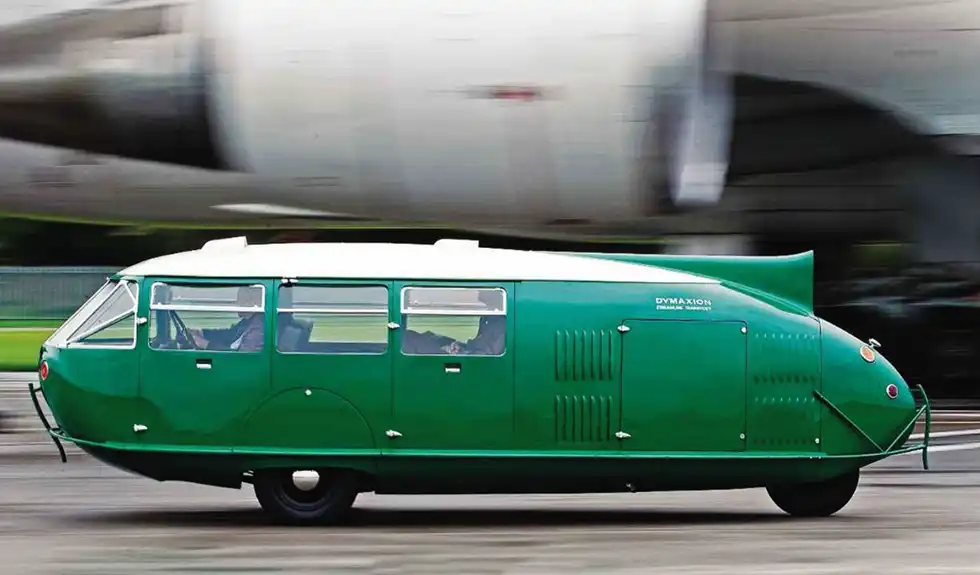
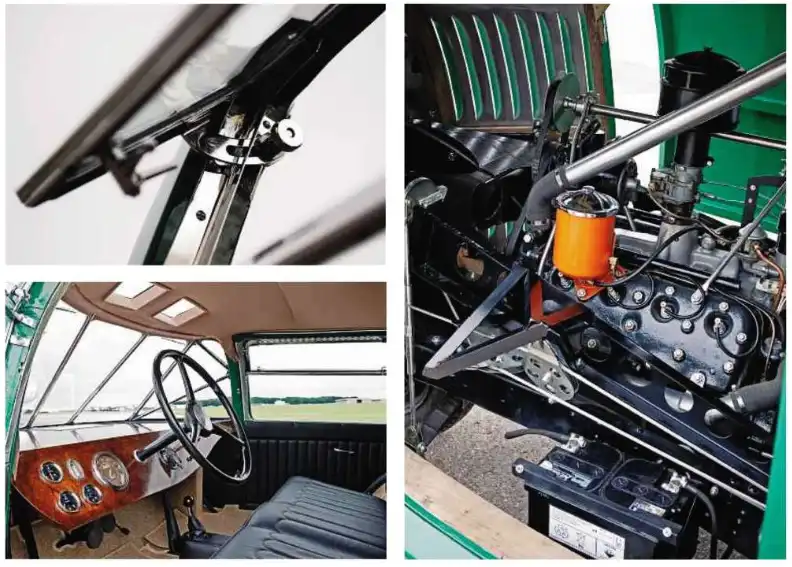
It is a three-wheeled vehicle with front-wheel drive, using a modified Ford live axle widened by eight inches. Power comes from a rear-mounted 3.6-litre Ford V8 engine, and the car measures an astonishing 20 feet in length. Thanks to its rear-wheel steering, it can rotate almost within its own footprint.
If that brief summary hasn’t already surprised you, then perhaps I have spent the past forty years writing about the wrong subject.
The name Dymaxion itself dates back to 1927, coined by advertising expert Waldo Warren. It combined the words dynamism, maximum, and tension. The term soon became the brand identity for Fuller’s experimental 4D (“fourth dimension”) enterprise, which aimed to rethink how people live, travel and build.
Fuller envisioned an entirely new way of living. He designed futuristic homes and cities, and the Dymaxion cars of the early 1930s formed part of this broader utopian concept.
Working alongside Fuller was Starling Burgess, an aviation pioneer, naval architect, and racing yacht designer. Their collaboration blended aeronautical thinking with automotive engineering.
Initial funding for the Dymaxion project came from wealthy aviatrix Anna “Nannie” Dale Biddle, one of Fuller’s earliest supporters. However, in 1933 she married Burgess, becoming the fourth of his five wives. Soon afterward Fuller’s partnership with them both collapsed.
Building the Dymaxion Prototypes
Despite the personal tensions, three Dymaxion prototypes were built in Connecticut.
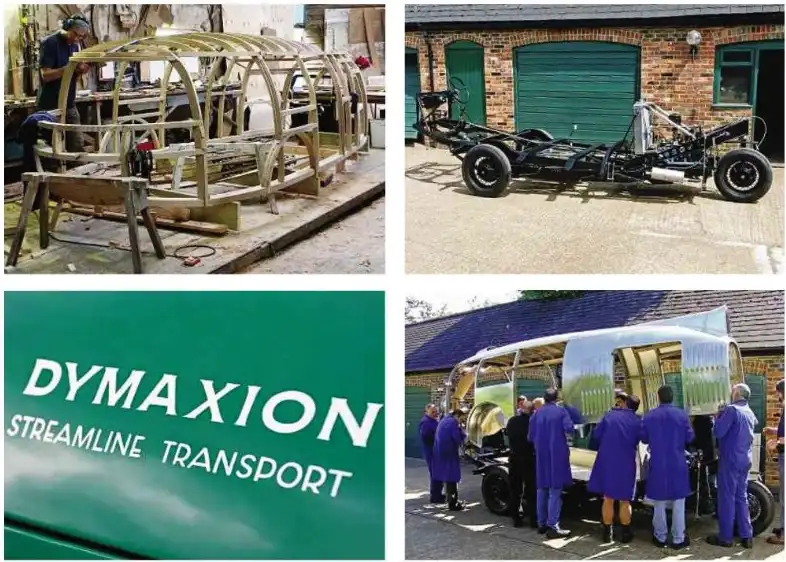
The engineering concept was relatively straightforward. A central platform carried the engine, gearbox, and front wheels, while a secondary frame supported the rear steering wheel. Above this sat a lightweight body structure — an ash wood frame covered with aluminium panels, constructed in a style closer to boat building than traditional car manufacture.
The flooring was plywood and the suspension relied on leaf springs at all three corners.
The first Dymaxion appeared in July 1933. It was significantly smaller than the two later versions completed in 1934.
The car you see today is based on prototype number three, recreated because Norman Foster wished to honour the legacy of Buckminster Fuller.
Why Norman Foster Rebuilt the Dymaxion
Norman Foster — officially Lord Foster of Thames Bank — founded the famous architectural firm Foster + Partnersin 1967. He remains one of the most influential architects in the world.
Among his many famous projects is London’s Swiss Re Building, widely known as “The Gherkin.”

During the 1970s, the young Foster collaborated directly with Buckminster Fuller on several projects. Their friendship and professional partnership deeply influenced Foster’s thinking.
Fuller passed away in 1983, yet Foster never forgot the mentor who shaped his early career. Commissioning a new Dymaxion car was his way of paying tribute.
Design research began within Foster + Partners. The firm’s head of design, David Nelson, helped coordinate the initial investigation.
Only one original Dymaxion survives today — car number two, preserved at Bill Harrah’s National Automobile Museum in Reno, Nevada. The museum allowed the team to study the vehicle closely, a crucial step in recreating the car accurately.
Without access to that surviving example, the project would have been nearly impossible.
Recreating a Futuristic Machine
Using surviving drawings, archival photographs, and forensic-level inspection, Crosthwaite & Gardiner meticulously recreated what is effectively an exact copy of Dymaxion car number three.
Several specialist companies assisted.
Boat builders Peter Freebody & Co, whose heritage stretches back 300 years on the Thames, crafted the ash frame using traditional marine techniques. The aluminium body panels were formed by Roach Manufacturing.
Crucially, the team resisted any temptation to modernise the design. Even so, Norman Foster appropriately named his creation Dymaxion Car Number Four.
A Vision of Future Mobility
This extraordinary concept from nearly a century ago still challenges our understanding of what cars could become.
Early automobiles were originally toys for the wealthy. Yet it quickly became clear that they were faster than horses and dramatically cheaper to operate.
By the 1920s, the motorcar had evolved into the fastest, most practical, and most comfortable form of personal transport.
That remains largely true today.
Cars have since become safer, more reliable, quicker, and — in real terms — cheaper to run.
Yet consumers have not always appreciated this progress.
Historically, motorists rarely prioritised fuel consumption because cars were already relatively affordable to operate.
Was the Motor Industry Too Conservative?
A common myth claims that the automotive industry resists innovation.
Buckminster Fuller certainly believed this when he introduced the Dymaxion.
But the truth is more complicated.
Manufacturers have always been willing to pursue new technology. What limits radical innovation is often consumer demand. Car buyers typically prioritise familiarity and personal image over experimental engineering.
History is filled with visionary manufacturers who failed because their cars were simply too unconventional.
The Dymaxion was one such example.
The Tragedy That Ended the Dymaxion Dream
Initially the first Dymaxion prototype attracted enormous publicity.
But tragedy struck in 1933, outside the Chicago World’s Fair.
The prototype was involved in a mysterious collision with another vehicle. The Dymaxion’s driver was killed.
Public opinion turned sharply against the car.
One eternal rule of automotive design is this: even if a machine is brilliant, no manufacturer can succeed if buyers fear ridicule.
Fortunately, the Dymaxion possessed a certain elegance that demanded respect despite its unusual form.
Aerodynamics Before Its Time
The Dymaxion’s teardrop shape suggested advanced aerodynamic thinking.
However, automotive aerodynamics is more complex than it first appears. Cars operate close to the ground, unlike aircraft or boats.
Later experiments proved that stability required different shapes.
Examples such as the Chrysler Airflow and William Stout’s Scarab, both introduced in 1934, explored similar ideas.
Both were commercial failures — largely because conservative buyers rejected their futuristic appearance.
Compared with them, the Dymaxion was even more radical.
Production success would have been unlikely.
Driving the Dymaxion Replica
Our test day took place at RAF Kemble, now known as Cotswold Airport.
Norman Foster arrived from Madrid flying his private jet, accompanied by his wife and children.
After his first drive, we asked him for his impressions.
“It’s like driving a boat,” Foster explained. “Everything happens slowly and smoothly. The panoramic view from the driver’s seat is incredible. I’m still slightly cautious, but I’m beginning to feel comfortable with it.”
He continued:
“Buckminster Fuller made many bold claims, but even if you question them, there is still real substance behind his ideas.”
Inside the Dymaxion
The interior is surprisingly spacious.
The passenger compartment is so large that I could stretch my legs fully without touching the seat in front.
The cabin is trimmed correctly with corded carpeting and black leather upholstery. A slot in the roof houses a concealed mirror for the rear passenger, while another mirror sits above the driver.
The ride quality is astonishingly smooth.
Because the rear wheel sits so far back, there is little sense of bouncing over bumps.
Behind the Wheel
When it was finally my turn to drive, the first thing I noticed was the panoramic view.
Sitting in the driver’s seat feels like occupying the cockpit of a 1930s airliner, surrounded by glass.
The controls appear fairly conventional. The three-speed Ford gearbox lever rises from the floor.
Despite the gearbox being more than eight feet behind the driver, the mechanism feels precise.
Acceleration is modest but smooth. On the runway we reached roughly 50mph, and the Dymaxion remained stable.
Turning, however, is the party trick.
With rear-wheel steering, the car pivots dramatically. The steering requires almost 12 turns lock-to-lock, and cables transmit motion to a large 92-tooth sprocket connected to the rear wheel.
It feels strange, but undeniably fascinating.
A Visionary Legacy
Buckminster Fuller was a natural showman and occasionally exaggerated his claims — including a supposed 120mph top speed.
That was unlikely.
But what matters is not whether every claim was correct.
What matters is that Fuller dared to imagine something radically different.
Visionaries like Fuller challenge the world to think differently. They may not always succeed, but their ideas spark innovation.
And without them, progress would stall.
Long may such brilliant minds continue to inspire us.
2010 DYMAXION CAR NUMBER 4
- ENGINE 3622cc Ford 'Flathead' V8, side-valve, single-barrel carburettor
- POWER 75bhp
- TRANSMISSION Three-speed manual, front-wheel drive
- STEERING Cables to single rear wheel
- SUSPENSION Front: live axle, semi-elliptic leaf springs, lever-arm dampers. Rear: A-frame, single semi-elliptic leaf spring, two lever-arm dampers
- BRAKES Drums front and rear
- WEIGHT 1837kg
- PERFORMANCE Not recorded, despite outrageous claims when new!